
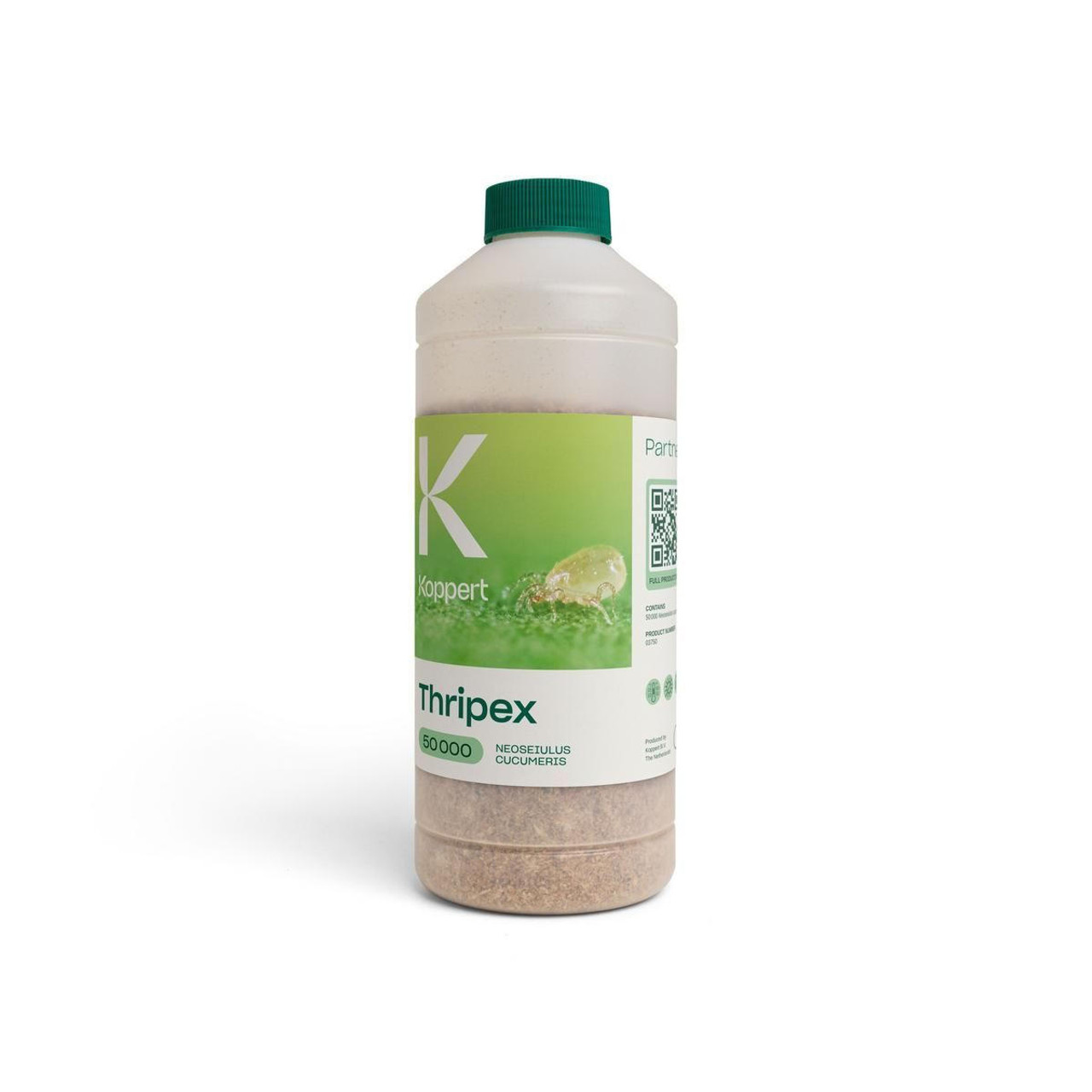

Thripex
Write a Review

Thripex
Thripex Bottles (Neoseiulus cucumeris) — Predatory Mite for Thrips and Mite Control
Thripex bottles contain active life stages of Neoseiulus cucumeris, a proven predatory mite for controlling thrips larvae and several mite species. These predators actively disperse across plant surfaces to consume target pests, delivering fast, targeted control in any growing environment. Thripex is chemical-free and safe for use in any growing environment including greenhouses, nurseries, orchards, flower beds, interiorscapes, outdoor landscapes, indoor plants including houseplants and more.
Thripex Product Sheet - Downloadable
Use For
Thripex targets young larvae of various thrips species, including
Western flower thrips (Frankliniella occidentalis)
Onion thrips (Thrips tabaci)
Other greenhouse and ornamental thrips (e.g., Echinothrips americanus, Thrips fuscipennis, Thrips simplex)
As a Type III generalist, Neoseiulus cucumeris also feeds on:
Broad mites (Polyphagotarsonemus latus)
Cyclamen mites (Phytonemus pallidus)
Spider mites
How It Works
Mode of Action: Mites pierce prey with their mouthparts and consume internal contents
Behavior: Mites disperse immediately across plant surfaces after release
Visual Effect: Pest populations decline as mites establish and feed
Application Method: Rotate bottle gently before use to distribute mites evenly. Tap bottle to release mites directly onto plant surfaces.
Feeding Rates:
Nymphs and adults feed on thrips larvae and mite eggs
Adults and late-stage nymphs consume 1-5 prey items per day under optimal conditions
Feeding life stages last ~20 days, depending on temperature and prey availability
Application Notes:
Adjust rates based on crop type, climate, and pest density
Rotate bottle gently before use
Sprinkle material directly onto leaves
Best Working Conditions
Temperature: Effective between 59–77°F; optimal range 68–77°F
Humidity: Sensitive below 70% RH
Compatibility Guidance
For chemicals compatibility details, check out our Natural Enemies - Chemical Compatibility Table and Beneficial Insect & Pesticide Compatibility Table
Allow residues from oils or soaps to dry before application
Do not use directly in combination with Swirskii, avoid combining with other Type III generalist predatory mites
Product Specifications
Pack Size: 50,000 predatory mites
Presentation: 1,000 mL bottle
Carrier: Vermiculite
Appearance: Mites are beige-pink and fast-moving; eggs are transparent white
What to Expect
Thripex bottles deliver high-density predatory mites that disperse immediately after application, targeting thrips larvae and small mites hiding in plant folds and undersides.
Visible pest reduction often begins within days as mites feed aggressively on larvae and eggs.
Works best when combined with preventative sachets and scouting for sustained control.
Recommended IPM Pairings
Horiver Yellow sticky traps for monitoring flying pests
Thripor for additional control over thrips populations
Spical or Spidex for comprehensive spider mite control
Isarid Mycoinsecticide for knockdown in high-pressure zones

Long-term storage, i.e. more than 48 hours, is not recommended. Apply promptly after receipt. Our products are shipped fresh for immediate use to ensure maximum performance. If needed, keep in a cool, dark, dry place for up to 1–2 days; longer holding reduces effectiveness and quality.
Yes - bottles contain a mix of life stages, including adults, juveniles, and eggs.
Yes, all of our soutions are completely safe for people, pets, and plants, making them ideal for enclosed environments like homes, offices, and interiorscapes.
Thripex bottles provide immediate predator release. Feeding starts immediately. Control builds quickly as predators move through affected areas.
Yes, Thripex is recommended for tomato crops. Tomatoes have natural resistances to certain predators, making it difficult for some predatory mites to maneuver and hunt on the plant. There is no harm to using Thripex in any set-up & Thripex is able to navigate tomatoes. For spider mite control in tomatoes, check out Spidex.
Yes - Neoseiulus cucumeris feeds on thrips larvae, broad mites, and other mites.
Other Products Growers Love
Thripex Plus Sachets (Neoseiulus cucumeris) — Predatory Mite for Thrips and Mite ControlThripex Plus…

Entonem (OMRI) — Steinernema feltiae - Nematodes for Soil and Foliar Pest Control Entonem contains t…

Thripor (Orius insidiosus) — Predatory Bug for Thrips ControlThripor contains Orius insidiosus, a pr…
Thripex-V Bottles (Neoseiulus cucumeris) — Predatory Mite for Thrips and Mite ControlThripex-V bottl…
Thripex-Mini Sachets with Sticks (Neoseiulus cucumeris) — Predatory Mite for Thrips and Mite Control…

General information When to use Isarid? Isarid™ works best in a pest management program designed…

Atheta — Dalotia coriaria (formerly Atheta coriaria)Dalotia coriaria, a species of rove beetle, is a…

Limonica (Amblydromalus limonicus) — Predatory Mite for Thrips & WhitefliesLimonica bottles contain …
