
Why Thrips on Cannabis Are Difficult to Control
Oct 05, 2026
Thrips on cannabis are difficult to control for several reasons. Their eggs are protected inside leaf tissue, they reproduce continuously on indoor plants, and the population is spread across three places at once. Larvae hatch and feed on the leaf surface. Mature larvae drop to the growing media to pupate, and the winged adults that emerge return to the canopy to lay the next round of eggs. A treatment aimed at one of those locations leaves the stages in the others to continue the cycle.
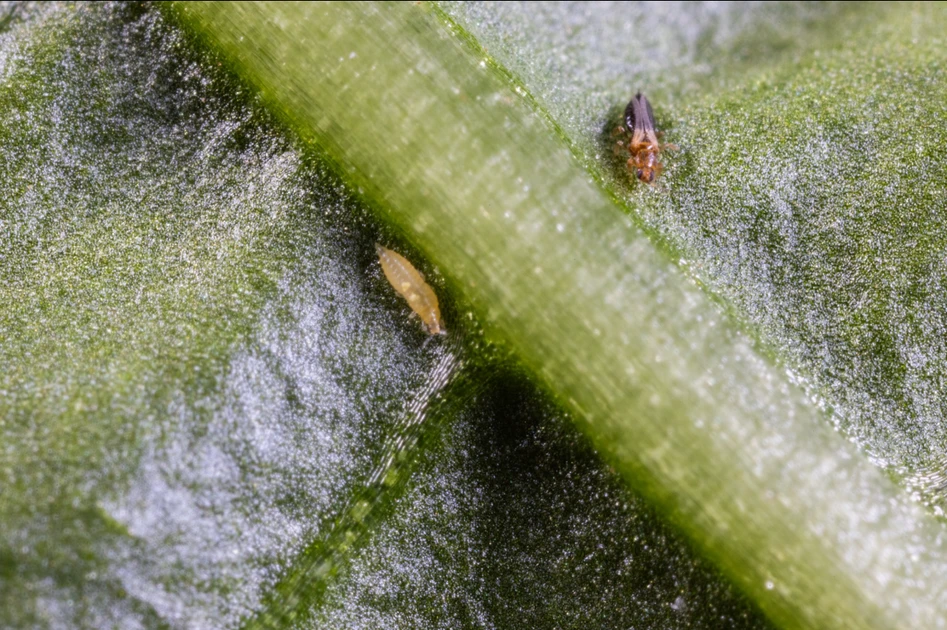
The damage is recognizable once you know what to look for. The upper leaf surface shows silver or pale flecks where the cells have been emptied, dotted with tiny black specks of droppings. Turn the leaf over and look for the larvae, pale yellow slivers that move when you disturb them. Western flower thrips and onion thrips are both confirmed on indoor cannabis.
How Thrips Get Into Indoor Cannabis Rooms
Thrips are carried in on live plants and cuttings, and they also enter through vents, fans, and other openings to the outside. If you are refilling rooms this fall or taking in new genetics as cuts, each tray that crosses the threshold is a possible introduction, including trays that look healthy.
That makes intake a practical place to intervene. Hold new cuttings apart from your production plants until you have checked them, and hang Horiver sticky traps at canopy height and near the air intakes. Count the cards weekly and record the numbers, so you can follow the trend across weeks as well as the individual counts. A rising trend indicates that more adults are emerging.
The Thrips Life Cycle on Cannabis and the Beneficial for Each Stage
Because the population lives in three places, a program that covers the life cycle puts a beneficial in each one. On the leaf, predatory mites do the work, and room temperature guides the choice between two species. Thripex contains Neoseiulus cucumeris, a predatory mite that feeds on thrips larvae and is effective between 59 and 77°F, which suits rooms that run cool. Swirski-Mite contains Amblyseius swirskii, which feeds on young thrips larvae and performs best from 68 to 90°F, which suits a warm room. Choose the one that fits your conditions. The two are not combined.
It helps to be clear about what these mites feed on. Both feed on young larvae on the leaf. The eggs inside the tissue and the adults are outside their prey range, so a program built on a leaf mite alone leaves pupae and adults in place. The media and the adults each need their own layer.
In the media, Entomite contains Stratiolaelaps scimitus, a soil dwelling predatory mite that feeds on thrips pupae. It also feeds on fungus gnat larvae, which share that space. Entonem contains beneficial nematodes that target thrips pupae and larvae and is applied as a drench. Keep the media moist before and after application, and drench weekly for at least two to three weeks.
That leaves the adults, the stage doing the egg laying. Thripor contains Orius insidiosus, a flying predatory bug that feeds on thrips larvae and adults. Of the beneficials in this program, it is the one that feeds on adult thrips. It performs best above 68°F and works more slowly in cooler rooms, and it is intended to be combined with a predatory mite, not to replace one.
Curative Bottles and Preventative Sachets for Thrips on Cannabis
Format matters alongside species. Bottle applications are curative and sachets are preventative. A bottle puts a large number of mites onto the canopy at once, and they begin feeding right away. Mites emerge from a sachet gradually, which suits prevention and is too slow on its own when larvae are already on the leaves. During an active problem, sachets can be hung alongside bottle applications, so prevention is in place as pressure comes down.
For active thrips on cannabis, start with bottles. Expect pressure to begin declining within a week to a week and a half of the first application. If your card counts and leaf checks have not dropped by then, repeat before the two week mark. Depending on severity, plan on weekly or every other week applications for two weeks to a month.
Once pressure is minimal, the program shifts to prevention. Thripex Plus sachets suit cooler rooms, and Swirski-Mite Ulti-Mite Sachets suit warm ones and provide four to six weeks of predatory mites per sachet. Mothers, clones, and veg plants are good places to hang them, since those plants supply the rooms that follow. Keep Entomite going in the media on a maintenance schedule so the pupal stage stays covered.
Building Your Thrips Program From Three Measurements
Three measurements inform these decisions: your card counts, your room temperature, and where on the plant you are finding larvae. Room temperature points to the mite. The counts and the leaf checks tell you whether you need curative bottles or preventative sachets, and whether the media and the adults need their own layer now. The cannabis page groups each of these beneficials by target, so you can build an order from your numbers.
Related Articles
How to Solve Thrips - the general thrips program across crops. Entomite: Soil Dwelling Predator for Fungus Gnats and Thrips Pupae - how the media layer works. Choosing the Right Predatory Mites - matching mite species to target and conditions.
