
What are Aphids? Identification, Life Cycle, and Biological Control
Jan 14, 2026
What are aphids and why do they matter?
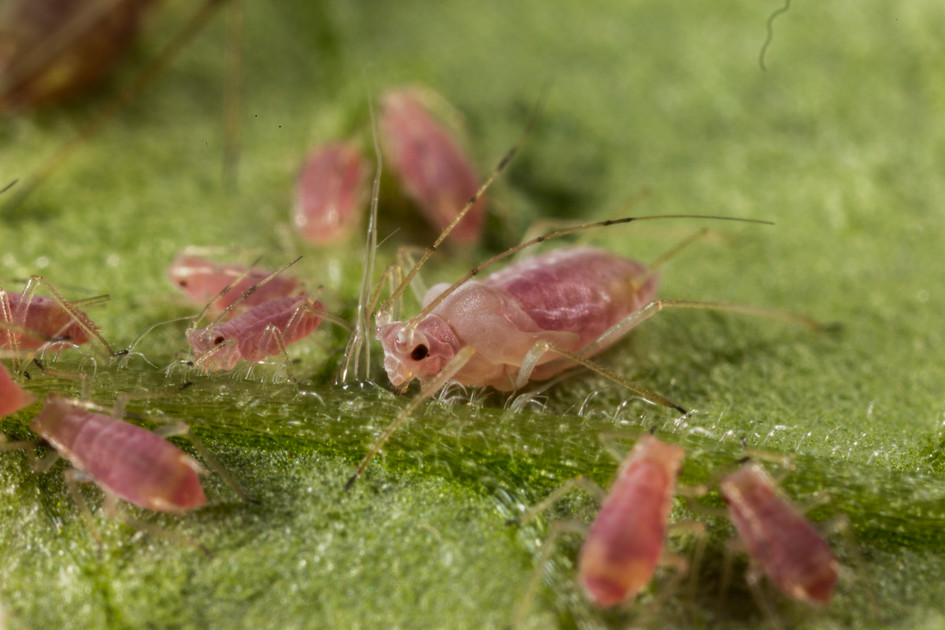
Aphids are small, soft-bodied insects that feed by piercing plant tissue and extracting sap directly from the plant's vascular system. Most are 1–4 mm long and pear-shaped, and they tend to cluster on the undersides of leaves, along stems, and in new growth where plant tissue is softest. That feeding weakens plants, distorts new leaves, and in some species triggers virus transmission. What makes aphids a persistent challenge is how fast they multiply: populations can go from a few individuals to a serious problem within two to three weeks if left unchecked. Understanding what aphids are and how they behave is the foundation of any effective aphid control program.
Common aphid species and how to identify them
There are over 4,000 described aphid species worldwide. While certain species are more commonly found on particular crops, aphids are not restricted to those hosts — the species present in your growing environment depends on what is actually there, not what is expected. Always identify the aphid species you are dealing with by observing the insects directly rather than assuming based on crop type alone. Species vary in color (green, yellow, black, pink, or waxy white), body shape, and preferred feeding location on the plant, all of which matter when selecting the most effective biological control agents.
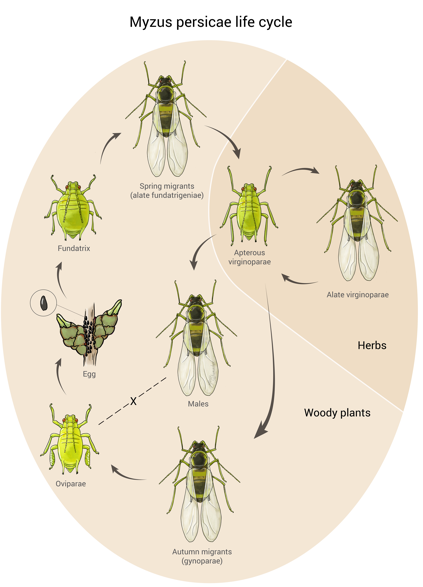
A few species cause the majority of problems in horticulture. The Green Peach Aphid (Myzus persicae) is one of the most damaging globally — it feeds on a wide range of vegetables and ornamentals and is a primary vector for dozens of plant viruses. The Cotton Aphid (Aphis gossypii) is common on cucurbits, chrysanthemums, and peppers. The Potato Aphid (Macrosiphum euphorbiae) appears across solanaceous crops and ornamentals. These names reflect where species are commonly found, but they can and do show up across many other plant types — scout for what is actually present.
How to find aphids before colonies build
Aphid colonies establish first in the parts of the plant that are easiest to overlook: leaf undersides, unfurling new growth, and the tight junctions where leaves meet stems. These sheltered spots offer soft tissue and protection, so early colonies often go unnoticed until they have already grown. Turn leaves regularly and examine growing tips closely during every scouting session — this is where problems start.
The first visible signs are often not the aphids themselves but what they leave behind. Mild distortion in new leaves — slight twisting, puckering, or uneven expansion — signals feeding is already underway. A developing shine on leaf surfaces is honeydew accumulating; as it builds up it becomes tacky and can turn black as sooty mold establishes on top of it. Shed cast skins, white and papery, collect along stems and leaf bases and are often easier to spot than the insects. Ants moving up and down stems consistently are actively tending an aphid colony somewhere above. Catching these signals early gives biological controls the best possible conditions to work. By the time distortion is severe or honeydew is heavy, the population has already had significant time to build. Learn more about how to solve aphids once a population is identified.
Why aphid damage compounds quickly
Aphid feeding does more than remove sap. Direct feeding stunts growth and curls leaves. The honeydew produced coats leaf surfaces, attracts ants, and feeds sooty mold — a black fungal growth that physically blocks light and makes plants unmarketable in ornamental and cut flower production. Virus transmission is the most serious consequence in many crops: species like Myzus persicae can transmit plant viruses during brief feeding probes, meaning even small populations can spread infection rapidly across a crop before visible aphid numbers would normally prompt a response.
Aphid life cycle and why populations grow so fast
Aphids reproduce without mating for most of the year — a process called parthenogenesis. This means females give birth directly to live young, skipping the egg stage entirely during the growing season. Those young begin reproducing within days of birth. The result is that a small undetected colony can become a large problem within two to three weeks. When a colony gets crowded or plant quality drops, winged forms develop and fly to new plants, starting fresh colonies elsewhere. In greenhouses and indoor growing environments where temperatures stay stable, this cycle runs year-round with no natural seasonal break.
Biological control of aphids: how it works
Biological aphid control uses natural enemies — parasitic wasps, predatory insects, and predatory midges — to reduce aphid populations without chemical intervention. The key principle is that no single beneficial insect resolves an aphid problem on its own, and no beneficial insect works from a single application. Parasitic wasps are the backbone of any aphid biocontrol program and require repeat applications to maintain pressure on the colony. Predators like lacewings and midges are most effective when used in combination with wasps, not as standalone solutions. Getting the right combination in place at the right pressure level is what determines results. The diagram below provides a starting framework.
Parasitic wasps: the foundation of aphid biocontrol
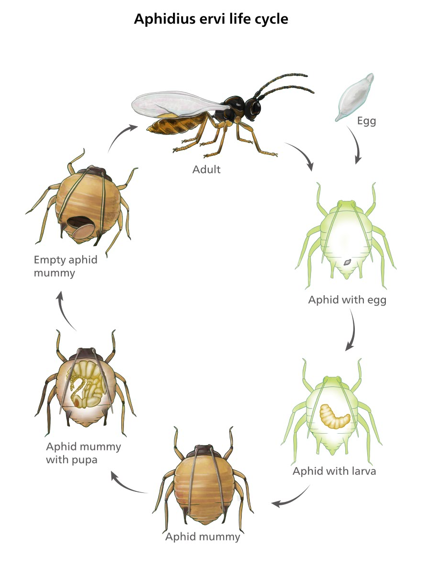
Parasitic wasps are the most important tool in a biological aphid control program and should be the first species introduced at any pressure level. Aphipar contains Aphidius colemani, a small wasp that lays a single egg inside an individual aphid. The aphid stops feeding and swells into a tan papery mummy, from which a new adult wasp emerges. Aphidius colemani works best against smaller species including green peach aphid and melon aphid. For larger-bodied species such as potato aphid, Ervipar contains Aphidius ervi, which targets hosts too large for colemani to parasitize effectively. Repeat applications are essential — a single release is not sufficient to bring a population under control. Weekly or biweekly applications sustained over two to four weeks are standard practice for active pressure.
Green lacewings for broad predation at all pressure levels
Chrysopa contains Chrysoperla carnea larvae — highly mobile predators that hunt actively through the canopy. Known as aphid lions, the larvae feed on all aphid life stages and move across leaf surfaces to locate colonies including those hidden in new growth or folded leaves. Lacewings are effective at both moderate and heavy pressure levels. At moderate pressure they complement parasitic wasps by providing direct predation while wasps work on colony interruption. At heavy pressure, repeated lacewing applications combined with repeated wasp applications form the core of the control program. Their broad prey range also makes them useful when multiple soft-bodied pests are present alongside aphids.
Aphidoletes midges as a support tool
Aphidend contains Aphidoletes aphidimyza, a predatory midge that works best as part of a combined program rather than as a standalone solution. Adults lay eggs near aphid colonies and the bright orange larvae feed on all aphid life stages, including larger adults. Aphidend supports the work of parasitic wasps and lacewings by providing additional predation pressure in dense canopy areas. It performs best in warm, humid greenhouse conditions. Aphidend should always be introduced alongside Aphidius wasps, not used independently.
Adalia lady beetle larvae for localized hotspots
Aphidalia contains Adalia bipunctata larvae, which are active aphid predators best used for targeted reduction of localized aphid hotspots. Each larva moves quickly across foliage and feeds on all aphid life stages. Because Aphidalia contains larvae rather than adults, it delivers immediate focused predation without the dispersal loss of adult beetles. Adalia works as a supporting addition to a wasp and lacewing program where concentrated colonies need faster local reduction. It is not a lead control tool and should always be used alongside repeated wasp applications.
How to run a biological aphid control program
Effective biological aphid control requires a planned program, not a single release. Start by identifying the aphid species present through direct observation — do not assume based on crop type alone, as species can appear on non-standard hosts. Select parasitic wasp species based on the aphid species identified: Aphidius colemani for small species, Aphidius ervi for larger species. Begin wasp applications early and repeat weekly or biweekly for at least two to four weeks depending on pressure. Add lacewing larvae as a predation partner from moderate pressure onward, also on a repeat schedule. Introduce Aphidend as a support tool in dense or humid environments. Add Adalia for hotspot reduction where colonies are heavily concentrated. Avoid broad-spectrum pesticides during the program and check the chemical compatibility tables before applying anything alongside beneficials. Monitor scouting results after each application to track whether populations are declining and adjust frequency accordingly.
Frequently asked questions about aphid control
Will biological control work indoors? Yes. Parasitic wasps and lacewing larvae are well-suited to enclosed indoor and greenhouse environments where conditions are stable. Aphidend midges perform particularly well in warm, humid indoor conditions. Repeat applications are still required regardless of environment.
How long until results are visible? Parasitic wasp mummies become visible within one to two weeks of release, indicating successful parasitism. Visible aphid population decline typically follows over the next one to two weeks with repeat applications. Predatory larvae provide faster visible impact in the short term. Results depend on pressure level, application frequency, and which species are used.
Can multiple natural enemies be released together? Yes, and combining species improves outcomes significantly. Parasitic wasps plus lacewings is the standard combination. Aphidend and Adalia are added as supporting tools for moderate to heavy pressure. All species should be on a repeat application schedule — combinations work because each targets aphids differently, but none work from a single release alone.
Related Articles
How to Solve Aphids - step-by-step biological control program for all growing environments.
Green Peach Aphid: Quick ID and Biological Control - species-specific identification and control guide.
Aphipar: Aphidius colemani for Aphid Control - full product guide for parasitic wasp applications.
Root Aphids: Identification, Life Cycle, and Natural Control - ID & Control guide for root aphid
