
Solving Fungus Gnats
Dec 05, 2025
Sciarid flies, commonly known as fungus gnats, are often dismissed as a nuisance in greenhouses. They’re almost unavoidable, as they can enter buildings as flying adults and develop through all life stages, multiplying rapidly. On older, healthy plants they’re fairly harmless, just annoying, but on younger, smaller plants that are not yet fully developed the feeding larvae can have a negative impact on growth, health, and yield.
At the larval stage fungus gnats actively feed on a plant’s root system. A high population can cause damage such as twisting, yellowing of the foliage, and leaf drop, and can actually stunt the plant’s growth. When working with cuttings, or getting plants to root or send out new branches it’s best to do everything possible to avoid fungus gnats.
These pests chow down on fungi, decaying organic material, and live plant tissue. In addition to feeding on roots, the larvae hollow out the stems of cuttings that are in the process of being rooted out. They thrive in wet, overwatered conditions and tend to exist in the upper soil profile but may live near drain holes as well.
Fungus gnat larvae and adults are also known vectors of plant diseases, a trait that is often underestimated or overlooked. Larval stages can directly transmit root rot from diseased plants to healthy ones, as well as Pythium, Fusarium oxysporum (Fusarium wilt), Verticillium albo-atrum, and Thielaviopsis basicola (black root rot). Adults are capable of spreading foliar diseases such as Botrytis by carrying the reproductive spores on their bodies.
Controlling fungus gnat adults and larvae starts with sound watering practices and proper drainage to aid in prevention. Maintaining sanitation is vital. Keep the growing area clean of debris, spilled growing media, algae, and pooling water. Pay special attention to drains, nearby cracks, and other small crevices that can serve as the perfect breeding ground for this pest. Screening windows and doors is recommended, as well as providing adequate ventilation and dry, level, weed-free floors.
What to look for
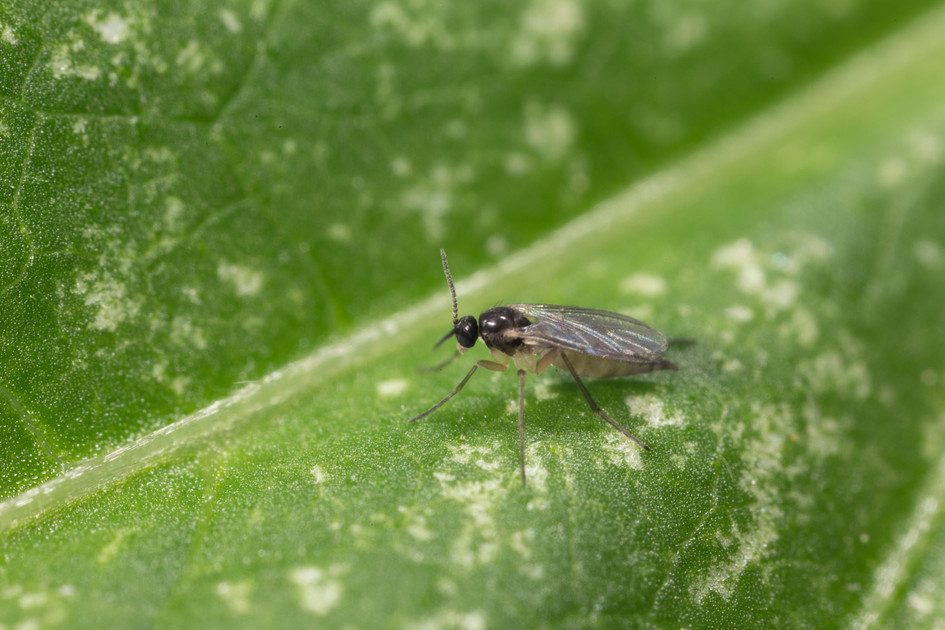
To try to avoid a problem in the first place, do not bring plant containers with pest populations indoors. That’s easier said than done, but it helps to know what the problem looks like. Fungus gnats resemble small mosquitoes and can usually be found crawling or flying low near the growing media or floor. Signs of fungus gnat pressure include stunted plant growth, adult fungus gnats hovering near the soil surface, and larvae in the soil. In the worst situations, their numbers can grow to a point where greenhouse employees are inhaling the insect during crop activities.
Life cycle of fungus gnats
There are four stages in the life cycle of fungus gnats, taking a total of 18 to 28 days, depending on the temperature. Developmental time increases as temperature decreases.
Egg: Eggs are laid by adult females in the cracks and crevices of moist soil, not directly on the soil surface. A female can lay between 75 and 200 eggs in her lifetime. The offspring of any given female will either be all males or all females.
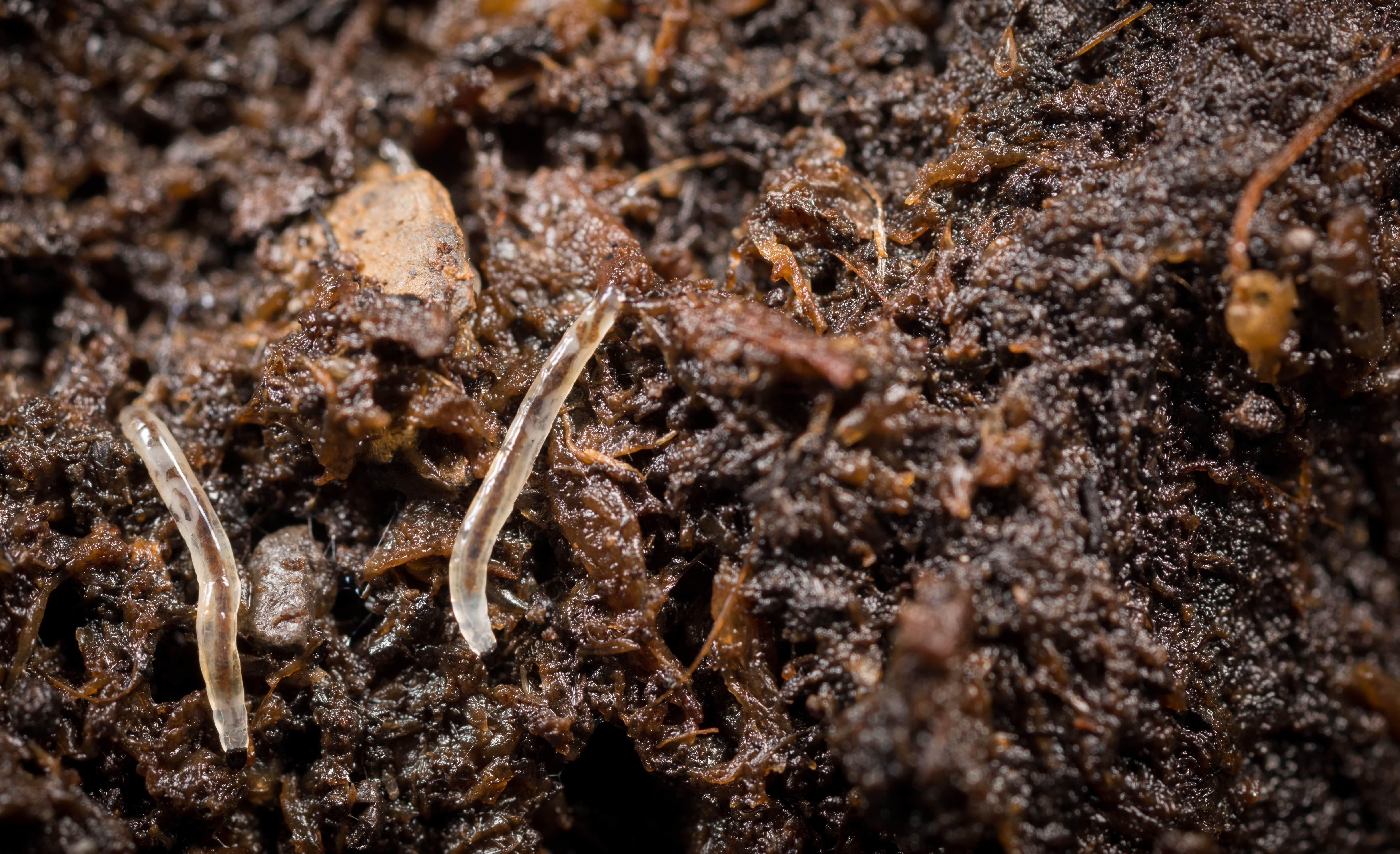
Larva: There are four larval stages, or instars, characterized by a black head capsule. Larvae feed on root hairs, stems of unrooted cuttings, and organic material. They may be located near the top of the container or the bottom.
Pupa: Larvae feed for about two weeks, then pupate near the soil surface for three to seven days. Pupal stage fungus gnats do not feed.
Adult: Adult fungus gnats emerge after pupation and live for about eight days. They’re dark, delicate-looking insects with slender legs, and can easily be distinguished by their bead-like antennae and Y-shaped wing vein. Adults are typically 1/8 to 1/16-inch long with wings that are light gray to clear. They have mandibles for gnawing and tunneling, and they are poor flyers.
Biology
Fungus gnats produce many generations in a year. They do not bite people or animals. If conditions are especially moist and the fungus gnat population is large enough, larvae can leave slime trails on the media surface that look like those of small snails or slugs. Adults feed very little, consuming only liquids such as water or flower nectar. They highly prefer wet soils to dry and favor growing media, as it’s rich in nutrients and remains constantly moist. Yellow sticky cards or potato slices monitored every 48 hours can be used to assess adult or larval populations, respectively.
I see gnats, now what?
There are a few options for control of fungus gnats. Some growers prefer to use nematodes such as Steinernema feltiae (Entonem). Others choose to go with predatory mites Stratiolaelaps scimitus (Entomite-M). Both of these biocontrols pair well with beneficial predatory beetles Dalotia coriaria (Atheta) to gain the upper hand on fungus gnats. Applying heavier amounts up front for two to three weeks in a row has been the most effective approach to overpowering a cycling fungus gnat population.
I don’t see any gnats but I’d like to prevent problems…
Fortunately the same predators used to clean up a fungus gnat population can work very well as preventatives. In that strategy the rate of application would be less. Applying every two to four weeks serves to keep the beneficials at high enough levels for prevention. An important rule of thumb: it’s best to introduce soil predators anytime you bring in new soil or transplant/pot up plants, in order to maintain root zone protection.
Deeper Dives
Sciarid flies gets down and dirty regarding the general appearance, life cycle (with illustrations), and damage symptoms of fungus gnats.
Predatory mites is an in-depth 101 about these beneficial biological agents—what they are, their advantages, which pests they control, how they are packaged, and how to use them (multiple video links included).
Entonem keeps young orchids free from fungus gnats is a look behind the scenes at how a large, international orchid grower combats fungus gnats using beneficial nematodes and predatory mites.
Beneficial nematodes explores the benefits of using these natural agents for biological pest control and the many plant pests they target.
Stratiolaelaps scimitus (Hypoaspis miles) delves into the life cycle and feeding behavior of this predatory mite and how to use it to its best advantage (there’s a video).
Steinernema feltiae takes a closer look at this particular nematode including how it works, the pests it targets, and how to apply it (with three videos).
