
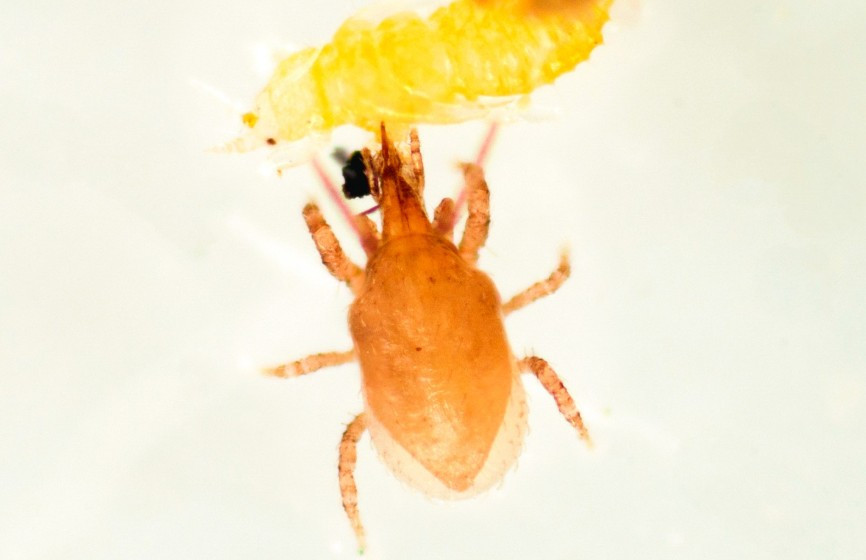
Entomite-M (Stratiolaelaps scimitus) — Soil-Dwelling Predator for Fungus Gnats & Thrips Pupae
Feb 06, 2026
Entomite-M contains Stratiolaelaps scimitus, a soil-dwelling generalist mite that targets fungus gnat larvae, thrips pupae, and other pests developing in soil or growing media. These predators actively patrol the top half-inch of soil or potting media, feeding on pest stages that foliar sprays and sticky traps can’t reach. Use Entomite-M as a potting amendment or sprinkle it on the soil surface for preventative and curative control in any growing environment.
Entomite-M is chemical-free and safe for use in any growing environment including greenhouses, nurseries, orchards, flower beds, interiorscapes, outdoor landscapes, indoor plants including houseplants and more.
Get Started: Entomite-M – Predatory Mite for Fungus Gnat
Key Advantages:
Targets hidden pests: Controls larvae and pupae in soil where sprays fail
Broad compatibility: Works with sticky traps, BTI drops, and beneficial nematodes as well as other beneficial predators
Low maintenance prevention: Works silently and out of view in your soil or potting medium to rid plants of fungus gnat larvae and other harmful soil dwellers.
Use For
Entomite-M feeds on soil-dwelling stages of:
• Fungus gnats (Bradysia spp.) — eggs, larvae, and pupae
• Thrips (Frankliniella occidentalis, Thrips tabaci, and others) — pupae in soil
• Root aphids — immature stages
• Springtails and other small soil invertebrates (in moderation/opportunistically and when no other prey is present)
When to Use Entomite-M
Use wherever soil-dwelling pests and/or fungus gnats are present or anticipated. Effective across all growing environments.
Recommended for:
Preventative incorporation into potting media during transplanting
Active control of Fungus gnats
Thrips management programs targeting pupal stages in soil
Root aphid control
Growers seeking long-term prevention & control
How It Works
Mode of Action: Nymphs and adults pierce and consume larvae and pupae in the top half inch of soil
Behavior: Predators actively search for prey in the top-layer of soil
Visual Effect: Pest populations decline steadily as mites establish and feed
Feeding Behavior & Rates
Larvae: Non-feeding stage
Nymphs and Adults: Feed on fungus gnat larvae, thrips pupae, immature root aphids, and other small soil invertebrates
Feeding Rate: Adult females consume up to 4.5 thrips pupae per day under optimal conditions
Lifecycle of Stratiolaelaps scimitus
Egg Stage
White, oblong; laid in moist soil
Hatch in ~6 days at 68°F
Larval Stage
Non-feeding; six-legged, white
Short duration before molting
Nymphal Stages
Eight-legged, light brown; actively feed
Feeding duration: ~10 days
Adult Stage
~1 mm, beige with brown shield; actively Feed
Lifespan: Several weeks; females lay ~2 eggs/day
Release Rates & Application
| Pressure Level | Definition | Rate per 10 sq ft | Repeat Interval |
|---|---|---|---|
| Preventative | No visible fungus gnats or pest pressure | 100–200 mites | Every 4 weeks, or upon repot |
| Low Pressure | Early signs of fungus gnats or thrips pupae | 200–300 mites | Every 4 weeks, or upon repot |
| Medium Pressure | Multiple areas affected; moderate pest activity | 300–400 mites (paired with foliar predator) | Every 3–4 weeks, or upon repot |
| High Pressure | Widespread pest presence; visible damage or high trap counts | 400–500 mites (paired with foliar predator) | Every 3–4 weeks, or upon repot |
Application Notes:
Tilt on side & rotate container gently before use to distribute predatory mites evenly within the container
Apply directly to soil or incorporate during transplanting
Avoid watering 10 minutes before and for a few hours after release
For cabinets, greenhouses and other areas where fungus gnats are harboring in non-plant material; Distribute into crevices, under benches, and around pipes
Best Working Conditions
Temperature: Minimum 59°F; optimal 68–77°F
Compatibility Guidance:
Allow residues from oils or soaps to dry before application
For chemicals compatibility details, check out our Natural Enemies - Chemical Compatibility Table and Beneficial Insect & Pesticide Compatibility Table
Product Specifications
Pack Sizes: 10,000; 50,000; 125,000 mites
Presentation: Cardboard tube
Appearance: Beige, droplet-shaped mites
What to Expect
Entomite-M begins working immediately as these predatory soil mites patrol and feed. For curative control of fungus gnats combine with sticky traps. If sticky traps catch large amounts of fungus gnats per week introduce Entonem for increased control. For control and prevention of thrips combine with Swirskii, Thripor, or Thripex.
Recommended IPM Pairings:
Horiver Yellow sticky traps for adult fungus gnat monitoring
Thripor or Thripex for foliar thrips control
Generalist foliar mites (Swirskii, Limonicus, Andersoni) and/or Thripor (Orius spp.) for full thrips control
Entonem (Steinernema feltiae) for enhanced fungus gnat larval suppression
Atheta (Dalotia coriaria) for broader soil pest coverage
Microbial dips (Microflora SA) for propagation trays
