
Pesticide Compatibility
Balancing pesticide compatibility with the use of beneficial insects can at times feel overwhelming, for the most straight forward insights, check out our digital tool compatability tool at Koppert One. This digital compatibility checker allows you to search by brand name, chemical, and predator, allowing for a quick check of chemical compatability. Once you've entered the chemical and beneficial, simply hover over the icons or click on the legend in the top right corner to see the compatability info. On this page we've summarized key insights from Koppert One's compatability database and common household products so you can understand how organic sprays, natural insect sprays for plants, and other treatments interact with beneficials such as predatory mites, parasitoids, and nematodes. Below we've also included some quick reference charts for compatability ' at-a-glance.'
Household and Garden Sprays
Many growers turn to familiar products for managing pests like spider mites, aphids, and fungus gnats. Captain Jack’s Dead Bug Spray, which contains spinosad, is a common choice for spider mite control in both houseplants and gardens. While spinosad is harmful to predatory mites such as Spical and Spidex if they are present during spraying, it can be used effectively as a knockdown treatment before beneficials are released. Monterey Garden Insect Spray, also based on spinosad, functions in the same way, providing strong knockdown against thrips and spider mites when applied prior to beneficial introductions.
Garden Tech Sevin Insect Killer, formulated with zeta‑Cypermethrin and bifenthrin, delivers broad knockdown power but leaves residues that are highly toxic to beneficials. For this reason, it should only be used before beneficial release, never during. Garden Safe Houseplant and Garden Insect Killer, which combines pyrethrins with canola oil, offers quick knockdown of aphids and mites. Beneficials can be released after the spray has dried, making it useful in between biological applications. Garden Safe Insecticidal Soap, made with potassium salts of fatty acids, is another natural insect spray for plants that works well against soft‑bodied pests like aphids. Once dry, beneficials can be safely introduced.
Bonide All Seasons Horticultural Oil, based on mineral oil, suffocates pests on contact. Oils can be disruptive if predators are present, but they are suitable as knockdowns before beneficial release. Bonide Insecticidal Super Soap behaves similarly to other soaps, providing effective knockdown and allowing beneficials to be introduced after drying.
Sprays That Require Extended Waiting Periods
Not all sprays fit the knockdown‑then‑beneficial strategy. Some products remain active in plant tissue or soil long after application, meaning beneficials cannot be applied for weeks. BioAdvanced Complete Insect Killer for Soil and Turf is one example. Because it is systemic, its active ingredients persist in plant tissue and soil, continuing to affect insects well beyond the initial spray. In these cases, beneficials should not be introduced until the chemical has fully broken down, which may take several weeks depending on conditions. Similarly, acephate‑based products are known to leave residues that remain harmful to parasitoids and predatory mites long after spraying, making them unsuitable for quick knockdown followed by biological release.
Compatibility Insights From Koppert Chart
The Koppert compatibility chart highlights how beneficials respond to common chemicals. Predatory mites such as Spical, Spidex, and Swirski Mite are very sensitive to spinosad, pyrethrins, and acephate, which means these chemicals should only be used as knockdowns before beneficial release. Parasitoids including Aphipar, Ervipar, and En‑Strip are highly vulnerable to pyrethrins and acephate, so knockdown use is possible but overlap must be avoided. Nematodes such as Entonem and Capsanem are generally tolerant of soaps and oils, though acephate can cause moderate harm. Pollinators like Natupol bumblebees must always be covered or removed before spraying, as many chemicals are incompatible.
Practical Guidance for Growers
The key is to view sprays and beneficials as complementary tools rather than conflicting ones. Sprays can be used as knockdowns when pest pressure is high, reducing populations quickly before beneficials are introduced. They can also be applied in between beneficial releases, provided residues are allowed to dry and predators are not present during spraying. However, growers should be aware that some systemic or long‑lasting sprays require extended waiting periods before beneficials can be safely applied. This distinction ensures that immediate suppression from sprays does not undermine the long‑term control provided by beneficials.
For spider mite pest control, biologicals such as Spidex Vital and Spical provide lasting control and work well with once knockdown sprays have reduced infestations. For aphid insect control, microbial products like Bacillus thuringiensis are generally safe and can be used alongside beneficials. When comparing root aphid vs fungus gnat issues, BT products remain safe for beneficials, while soaps and oils should be reserved for knockdown use. Growers looking for tomato plant insect repellents, red spider mite insecticides, or organic sprays for aphids should always check compatibility first to ensure beneficials can thrive after treatment.
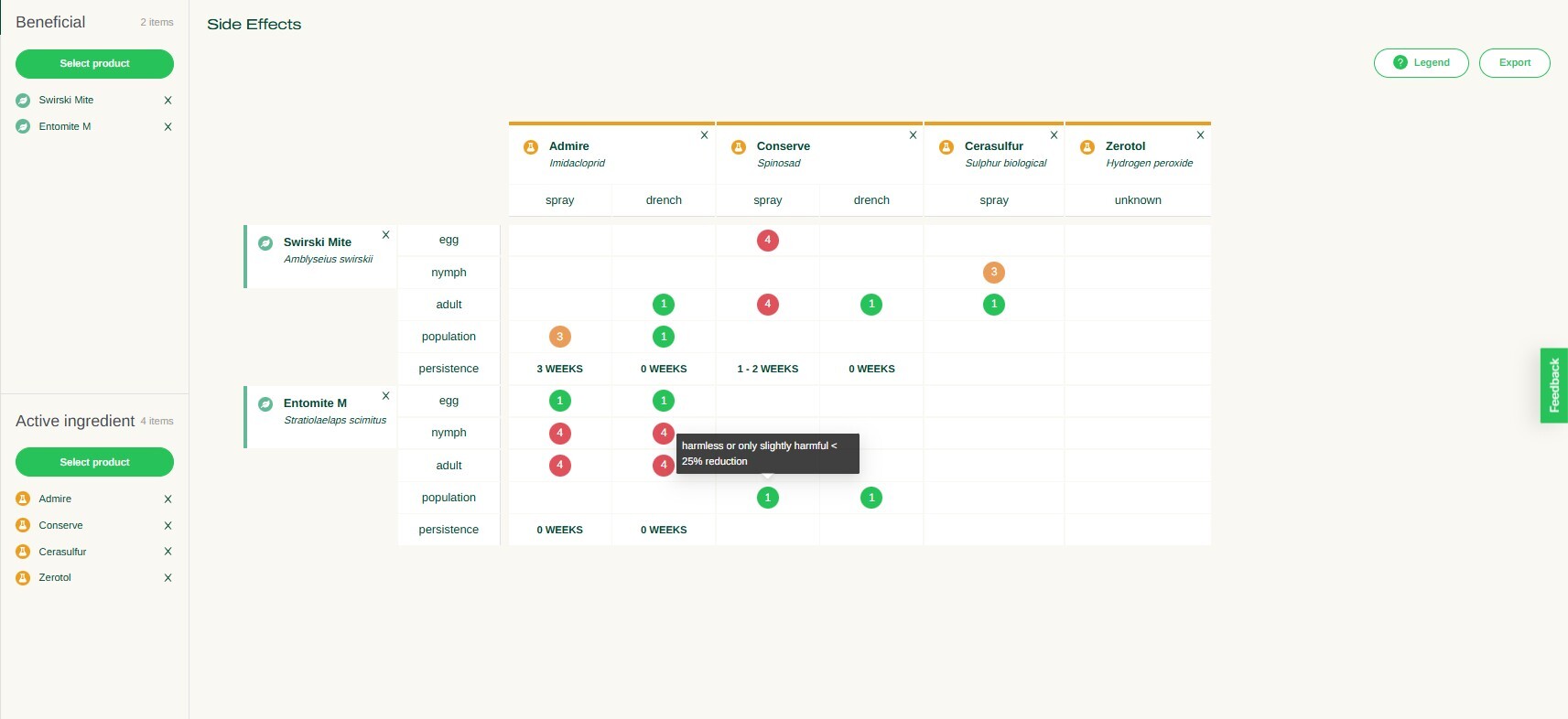
Quick Reference Chart #1
The below chart rates the active ingredient in some of the most common pesticides for home growers. Some chemicals have a low or no mortality rate of commonly used beneficial insects. Other chemicals have a high mortality rate. These should be used with caution or not at all.
- Low to No Mortality Rate = A few losses, but generally safe to use.
- Low to Moderate Mortality Rate = Has an effect, but many beneficals will survive.
- Moderate Mortality Rate = Some will survive, but a lot of beneficials will be lost.
- Moderate to High Mortality Rate = Pretty aggressive. Most beneficials will be gone.
- High Mortality Rate = Pretty effective in killing all beneficials.
| Household Product | Active Ingredient | General Compatibility with Commonly Used Beneficial Insects |
|---|---|---|
| Arber Organic Bio Insecticide | Heat-killed burkholderia spp, strain A396 | No - Moderate Mortality Rate |
| Trifecta Crop Control | Essential Oils (Thyme, Clove, Garlic, Peppermint, Corn, Geraniol, and Rosemary) & Citric Acid | No - Moderate Mortality Rate |
| Mighty Mint Plant Pest Protection | Essential Oils (Peppermint, Rosemary, and Geraniol) | No - Moderate Mortality Rate |
| Fungus Gnat Death Drops | Bacillus thuringiensis (israelensis Strain BMP 144) | Yes - Low to No Mortality Rate |
| Monterey Garden Insect Spray | Spinosad | No - Moderate to High Mortality Rate |
| Neem Oil | Neem Extract | No - Low to Moderate Mortality Rate |
| Bonide All Seasons | Mineral Oil | No - Moderate to High Mortality Rate |
| Southern Ag Natural Pyrethrin | Pyrethrin | No - Moderate to High Mortality Rate |
| Safer Brand Toamato & Vegetable | Pyrethrins & Potassium Salts of Fatty Acids | No - Moderate to High Mortality Rate |
| Bonide Insecticidal Soap | Potassium Salts of Fatty Acids | No - Moderate to High Mortality Rate |
| Bonide Systemic Housplant Insect Control | Acephate | No - High Mortality Rate |
| Bonide Captain Jacks Dead Bug | Spinosad | No - Moderate to High Mortality Rate |
| Ortho Insect Killer Rose & Flower | Deltamethrin | No - High Mortality Rate |
| Bonide Eight Insect Control | Permethrin | No - Moderate to High Mortality Rate |
| Safer Brand Insect Killing Soap | Potassium Salts of Fatty Acids | No - Moderate to High Mortality Rate |
| BioAdvanced Organics Houseplant Insect Killer and Mite Control | Sulfur & Pyrethrins | No - Moderate to High Mortality Rate |
| Garden Safe Houseplant and Garden Insect Killer | Pyrethrins & Canola Oil | No - Moderate to High Mortality Rate |
| Bayer Advanced Natria Insecticidal Soap | Potassium Salts of Fatty Acids | No - Moderate to High Mortality Rate |
| Raid House & Garden Insect Killer | d-Phenothrin & Prallethrin (Synthetic Pyrethroids) | No - High Mortality Rate |
| Sevin Insect Killer Dust | zeta-Cypermethrin & Bifenthrin | No - High Mortality Rate |
| STEM Kills Plant & Garden Insects | Cedarwood Oil & Sodium Lauryl Sulfate | No - low to Moderate Mortality Rate |
Quick Reference Chart #2
The table below addresses the effects of various chemicals on beneficial insects. These are substances found in a typical growing environment in fertilizers, growth moderators, or other common products.
- Koppert products are listed in the left hand column.
- Various chemicals run across the top.
- Find the cell where the product and chemical meet.
| Species | Potassium salts of fatty acids | Cyantraniliprole (cyazypyr) | Acephate | Bacillus subtilis | Calcium polysulfide | Chlorothalonil | Copper sulfate | Copper oxychloride | Copper hydroxide | Pyrethrins |
|---|---|---|---|---|---|---|---|---|---|---|
| Entonem Steinernema feltiae |
Harmless or only slightly harmful | Harmless or only slightly harmful | Moderately Harmful | Not listed | Not listed | Harmless or only slightly harmful | Harmless or only slightly harmful | Harmless or only slightly harmful | Harmless or only slightly harmful | Harmless or only slightly harmful |
| Capsanem Steinernema carpocapsae |
Harmless or only slightly harmful | Not listed | Moderately Harmful | Not listed | Not listed | Harmless or only slightly harmful | Not listed | Harmless or only slightly harmful | Not listed | Harmless or only slightly harmful |
| Natupol Bombus terrestris |
Cover bees | Remove | Incompatible | Cover bees | Not listed | Cover bees | Cover bees | Cover bees | Remove | Remove |
| Chrysopa Chrysoperla carnea |
Very Harmful | Harmless or only slightly harmful | Very Harmful | Not listed | Not listed | Harmless or only slightly harmful | Not listed | Moderately Harmful | Not listed | Moderately Harmful |
| Cryptobug Cryptolaemus montrouzieri |
Not listed | Very Harmful | Not listed | Moderately Harmful | Not listed | Harmless or only slightly harmful | Not listed | Not listed | Harmless or only slightly harmful | Not listed |
| Cryptobug L Cryptolaemus montrouzieri |
Not listed | Very Harmful | Not listed | Moderately Harmful | Not listed | Harmless or only slightly harmful | Not listed | Not listed | Harmless or only slightly harmful | Not listed |
| Ervipar Aphidius ervi |
Very Harmful | Harmless or only slightly harmful | Very Harmful | Not listed | Harmless or only slightly harmful | Moderately Harmful | Not listed | Not listed | Not listed | Harmful |
| Aphipar Aphidius colemani |
Very Harmful | Harmless or only slightly harmful | Very Harmful | Not listed | Harmless or only slightly harmful | Moderately Harmful | Not listed | Not listed | Not listed | Very Harmful |
| En Strip Encarsia formosa |
Very Harmful | Not listed | Very Harmful | Not listed | Very Harmful | Harmless or only slightly harmful | Not listed | Harmful | Not listed | Very Harmful |
| Spidex Vital Phytoseiulus persimilis |
Very Harmful | Not listed | Very Harmful | Not listed | Harmless or only slightly harmful | Harmless or only slightly harmful | Not listed | Harmless or only slightly harmful | Not listed | Very Harmful |
| Swirski Mite Amblyseius swirskii |
Harmful | Harmless or only slightly harmful | Very Harmful | Not listed | Not listed | Moderately Harmful | Not listed | Not listed | Not listed | Not listed |
| Ulti Mite Swirski Amblyseius swirskii |
Harmful | Harmless or only slightly harmful | Very Harmful | Not listed | Not listed | Moderately Harmful | Not listed | Not listed | Not listed | Not listed |
| Thripex Neoseiulus cucumeris |
Very Harmful | Harmful | Very Harmful | Not listed | Not listed | Moderately Harmful | Not listed | Harmless or only slightly harmful | Not listed | Not listed |
| Thripor I Orius insidiosus |
Not listed | Harmless or only slightly harmful | Very Harmful | Not listed | Harmless or only slightly harmful | Harmless or only slightly harmful | Not listed | Not listed | Not listed | Not listed |
| Entomite M Stratiolaelaps scimitus |
Very Harmful | Not listed | Very Harmful | Not listed | Not listed | Harmless or only slightly harmful | Not listed | Harmful | Not listed | Not listed |
| Spical Neoseiulus californicus |
Very Harmful | Not listed | Very Harmful | Not listed | Not listed | Harmless or only slightly harmful | Not listed | Moderately Harmful | Not listed | Very Harmful |
