
What Is Entomite‑M?
Jan 28, 2026
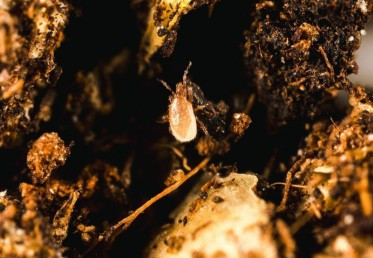
Entomite‑M is a soil‑dwelling predatory mite used to control fungus gnats, shore flies, and other pests that develop in growing media. Instead of working on leaves or flying adults, Entomite‑M works below the surface—targeting immature pest stages where sprays and surface controls often miss them.
Entomite‑M is used in greenhouses, nurseries, propagation areas, indoor plant systems, and other protected growing environments. It can be used preventatively to keep populations from building, or during active pressure as part of a broader IPM program.
The Predator in Entomite‑M
Entomite‑M contains the predatory mite Stratiolaelaps scimitus (formerly Hypoaspis miles).
This species lives and hunts in the upper layers of growing media, where fungus gnat larvae, shore fly larvae, and soil‑dwelling pupae are concentrated. It is highly mobile in substrate and well adapted to greenhouse and indoor production systems. Entomite-M can also be applied on benches, in crevices and on the ground in order to target pockets of fungus gnat larvae that may be hidden on various services outside of soil.
Only the nymphal and adult stages are predatory and responsible for pest suppression.
Target Pests
Entomite‑M targets pests that spend part of their life cycle in growing media, including:
- Fungus gnat larvae
- Shore fly larvae
- Soil‑dwelling thrips pupae
- Other small soil‑associated arthropods
By suppressing immature stages, Entomite‑M reduces the number of adults emerging over time, helping lower overall pressure rather than focusing on adult knockdown alone.
How Entomite‑M Works
Entomite‑M is sprinkled onto the surface of the growing media. After application, the predatory mites naturally move down into the soil through pore spaces and crevices, establishing themselves where soil‑dwelling pests develop.
Once in the media:
- Predators begin feeding on larval and pupal stages
- Activity remains concentrated in the upper soil layers
- Mites stay active in moist growing media
- Populations can persist even as pest levels fluctuate
Entomite‑M does not need to be buried or mixed in. The mites distribute themselves naturally within the soil profile.
Preventative Use
When used preventatively, Entomite‑M helps keep fungus gnat and shore fly populations from establishing.
Preventative use is most effective:
- In propagation and young plant production
- In consistently moist growing systems
- When pest pressure is low or just beginning
If populations are minimal and irrigation can be spaced out, Entomite‑M may be sufficient on its own to keep pressure under control.
Use During Active Pest Pressure
Entomite‑M can be used during an active problem, but it functions best as a supporting biological, not a standalone solution for heavy pressure.
During established fungus gnat or shore fly activity:
- Entomite‑M applies ongoing pressure in the soil
- It suppresses new larvae and pupae as part of recovery
- It helps stabilize populations after faster controls are used
While Entomite‑M typically cannot resolve a heavy, established problem by itself, it plays an important role in regaining and maintaining control when used correctly.
Recommended IPM Pairings
Entomite‑M performs best as part of a layered approach that addresses multiple life stages.
Entonem (Steinernema feltiae)
Entonem provides rapid suppression of larvae in the soil. Entomite‑M complements nematodes by maintaining longer‑term biological pressure once nematode activity tapers off.
Horiver Sticky Traps or Discs
Yellow sticky traps and Horiver Discs reduce adult populations, limiting egg‑laying and slowing reinfestation. Reducing adult pressure improves the effectiveness of soil‑based controls.
Together, these tools work cooperatively—reducing adults, larvae, and pupae rather than relying on a single tactic.
What Entomite‑M Can — and Cannot — Do
Entomite‑M can:
- Suppress larvae and pupae in growing media
- Reduce adult emergence over time
- Support control during active pressure
- Maintain stability once populations are reduced
Entomite‑M typically cannot:
- Quickly eliminate a severe, established problem on its own
- Control flying adults directly
Setting realistic expectations is key to long‑term success.
Where Entomite‑M Is Commonly Used
Entomite‑M is commonly used in:
- Potted plants and containers
- Propagation trays and plug production
- Greenhouse benches and floors
- Structural areas, crevices, and drain zones where soil pests develop
Because it works in the growing media, performance is not affected by plant size or canopy density.
Summary
Entomite‑M is a soil‑dwelling predatory mite used to control fungus gnats, shore flies, and other soil‑associated pests at their source. Applied to the surface and naturally moving into the soil, the predators establish where larvae and pupae develop.
Entomite‑M can be used preventatively and also plays an important supporting role during active pest pressure, especially when paired with Entonem and adult monitoring tools. Rather than acting alone, Entomite‑M works best as part of a cooperative IPM program—helping regain control and maintain balance below the surface.
