
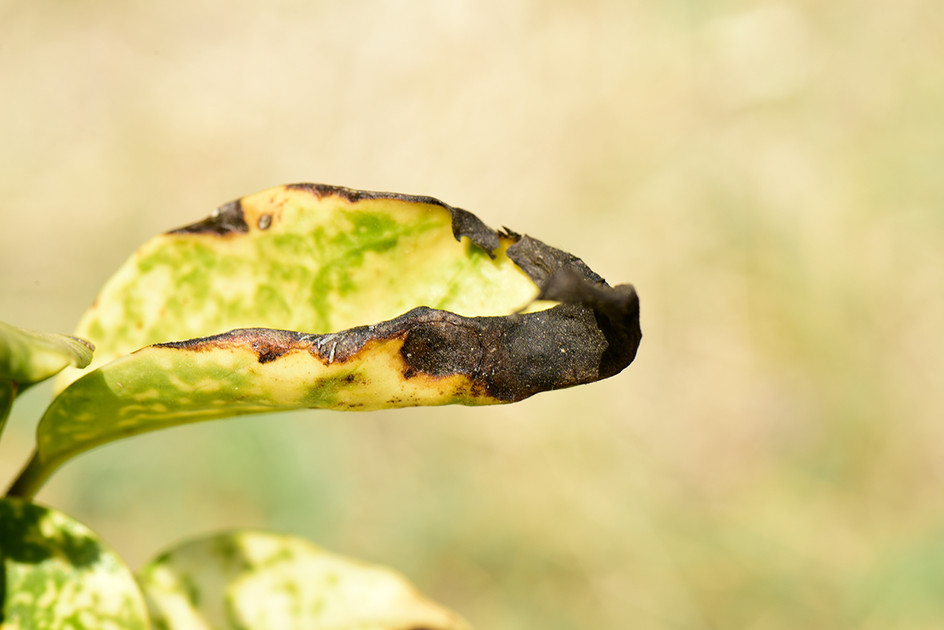
What Causes Sticky Residue on Plants & How to Diagnose Sooty Mold
Dec 10, 2025
Sticky residue on foliage is one of the most reliable early-warning signs of a sap-feeding insect problem. Before colonies become visible, before leaves distort, and before plant vigor noticeably declines, honeydew often appears as a glossy, tacky film on foliage. As this sugary residue accumulates, sooty mold fungi develop on its surface, forming dark, powdery coatings that interfere with photosynthesis. Professional growers depend on this early symptom because it frequently appears days to weeks before pests are spotted directly. This guide explains how honeydew forms, how different pests create different residue patterns, how to separate biological causes from environmental or cultural ones, and how to identify and act on sooty mold effectively.
1. What Sticky Residue Actually Indicates
Honeydew is a sugary waste product excreted by sap-feeding insects when they ingest more plant sap than they can metabolize. The excess sugar is expelled as a sticky liquid that coats leaves, stems, benches, irrigation lines, and even floor surfaces. According to the Royal Horticultural Society (RHS), honeydew forms where insects such as aphids, mealybugs, scale insects, and whiteflies are feeding, and sooty mold often colonizes this residue soon after (RHS, 2020). Because these pests often feed on the undersides of leaves or deep within canopy structures, the first visible symptom on the upper leaf surface is frequently this sticky sheen rather than the insects themselves.
Growers should understand that honeydew is not random—it appears directly below feeding sites. If you notice a glossy film on lower leaves or benches, check the plant parts above that area. This pattern helps pinpoint the pest location even before colonies are visible. Honeydew also signals active feeding, meaning the pest population is not dormant and intervention is needed.
2. How to Confirm Honeydew Versus Environmental Residues
Not all sticky substances are honeydew. Foliar sprays, fertilizers, or condensation can leave tacky films, but these residues behave differently. Honeydew feels sweet and syrup-like, thins under warm conditions, and continues to accumulate daily until pests are controlled. It often appears in droplets or streaks directly beneath feeding sites, not randomly across the leaf. Ants may be present, actively tending the insect colony (RHS, 2020), and sooty mold often follows honeydew accumulation.
Environmental residues lack these features. Spray deposits dry hard or powdery and do not spread over time. Fertilizer films may leave crystals rather than sticky layers. If residue persists and expands, especially with ants or mold present, it is almost certainly honeydew. A quick test: wipe the leaf with a gloved finger. Honeydew feels slick and sticky, while spray residue feels gritty or dry.
3. Early Signs of Sooty Mold and Why It Matters
Sooty mold is not a plant disease but a group of fungi that grow on the sugar-rich honeydew left by pests. It appears as a charcoal-colored, powdery film. While the fungi do not infect the plant internally, they block light and reduce photosynthesis, which can slow growth and affect crop quality (RHS, 2020). Heavy mold layers can also interfere with gas exchange and make foliage look unhealthy. Where sooty mold appears, honeydew-producing pests are almost always present, and this usually means the infestation has moved beyond the earliest stage.
4. Honeydew-Producing Pests and Their Distinctive Patterns
Different pests leave different clues. Aphids prefer tender new growth and produce heavy honeydew that drips onto lower leaves. Colonies cluster on shoot tips and undersides of expanding leaves, often accompanied by curling and ants (UC IPM, 2021). Whiteflies create a fine, dust-like coating on leaf undersides, and adults fly up when disturbed. Their nymphs produce honeydew that quickly supports sooty mold (UC IPM Whiteflies, 2021). Mealybugs leave sticky residue in leaf joints—where the leaf meets the stem—and along stems, mixed with cottony wax clumps (RHS, 2020). Scale insects stay fixed in one spot, and honeydew pools beneath them, often with thick sooty mold and ant activity (RHS, 2020).
5. Distinguishing Honeydew From Guttation, Overhead Irrigation, or Foliar Residue
Plants can release water droplets through guttation, but these appear at leaf tips, look like beads, and do not form sticky films. Overhead irrigation leaves temporary spots that evaporate and do not support mold. Fertilizer residue dries into crystals or powder, not sticky layers. If residue keeps appearing and begins to support sooty mold, it’s honeydew.
6. What Sticky Residue Tells You About Pest Stage and Severity
Honeydew means pests are actively feeding. A few droplets suggest an early infestation. A uniform sticky film across leaves signals a mature colony. Sooty mold indicates multiple generations have fed and the population is well established (RHS, 2020). This progression helps growers decide how urgently to act. If honeydew is spreading daily, biological control releases should begin immediately.
7. The Role of Ants in Diagnosing Honeydew Producers
Ants are one of the strongest indicators of honeydew-producing pests. They protect aphids, mealybugs, and some scale species in exchange for honeydew (UC IPM, 2021). Where ants are active, pest colonies often grow faster, and biological controls like parasitoids may struggle. If ants are moving along stems or pot edges, check nearby foliage for sticky residue and hidden pests. Managing ants is often essential for successful IPM.
8. Sooty Mold as an Indicator of Crop Loss Risk
Sooty mold itself is superficial, but it signals heavy pest pressure. Thick mold layers block light, reduce photosynthesis, and can stunt growth or dull flower color. In edible crops, blackened leaves reduce marketability even after pests are gone. Mold becomes harder to remove as it builds up, so early intervention is key. If mold is visible, pest populations are already advanced.
9. Inspection Protocol: How Growers Should Track Sticky Residue
Use honeydew as a roadmap. Inspect leaves directly above sticky surfaces, check stems and growth tips for colonies, and watch for ants or mold spreading across lower foliage. Pay attention to warm, sheltered zones with low airflow—these areas favor sap-feeding pests. Residue patterns often reveal hotspots before pests are visible. Combine this with sticky-card monitoring for a complete picture.
10. Biological Control Strategies for Honeydew-Producing Pests
Once honeydew is confirmed, target the pest group. Aphids respond to parasitoids like Aphidius spp. and predators such as Aphidoletes aphidimyza and lady beetles. Whiteflies require Encarsia formosa or Eretmocerus eremicus. Mealybugs call for Cryptolaemus montrouzieri or Chrysoperla carnea. Scale insects need species-specific parasitoids and predators, sometimes combined with careful manual removal. Early releases work best before honeydew and mold become heavy.
11. When to Escalate to Microscopy or Additional Diagnostics
If sticky residue is present but pests are hard to find, look deeper. Some scale species hide under bark or in crevices, and mealybugs may stay tucked in leaf joints. Dense canopies may require magnification to confirm pests. If sooty mold appears but no obvious source is found, consider less common honeydew producers like psyllids or leafhoppers and expand scouting to stems and lower foliage.
If you’re unsure, use our Live Chat or Consultation Form for real-time help. Our team can guide you through advanced inspection techniques and help confirm the pest group quickly.
12. Summary: How Professionals Use Sticky Residue as an Early Warning System
Sticky residue is one of the earliest and most dependable signs of sap-feeding insect activity. By learning to recognize honeydew, confirm its source, and act before colonies explode, growers can prevent crop loss and maintain quality. Combine visual checks with monitoring tools, and when questions arise, reach out through Live Chat or submit a Consultation Form for expert guidance. Together, we can keep your IPM program proactive and effective.
References
Royal Horticultural Society (RHS). “Houseplant pests: sap-feeding insects.” 2020.
UC Statewide Integrated Pest Management Program (UC IPM). “Aphids: Management and Diagnosis.” 2021.
UC Statewide Integrated Pest Management Program (UC IPM). “Whiteflies in Floriculture and Ornamental Nurseries.” 2021.
Texas A&M AgriLife Extension IPM. “Diagnosing Insect and Mite Damage" 2020.
