
What are Aphids?
Dec 02, 2025
Aphids are among the most common and destructive pests for both home gardeners and commercial growers. These tiny insects may look harmless, but their rapid reproduction and feeding habits can quickly overwhelm plants. Left unchecked, they not only damage leaves and stems but also spread plant viruses, making them a top concern for anyone serious about healthy, thriving crops.
What Are Aphids?
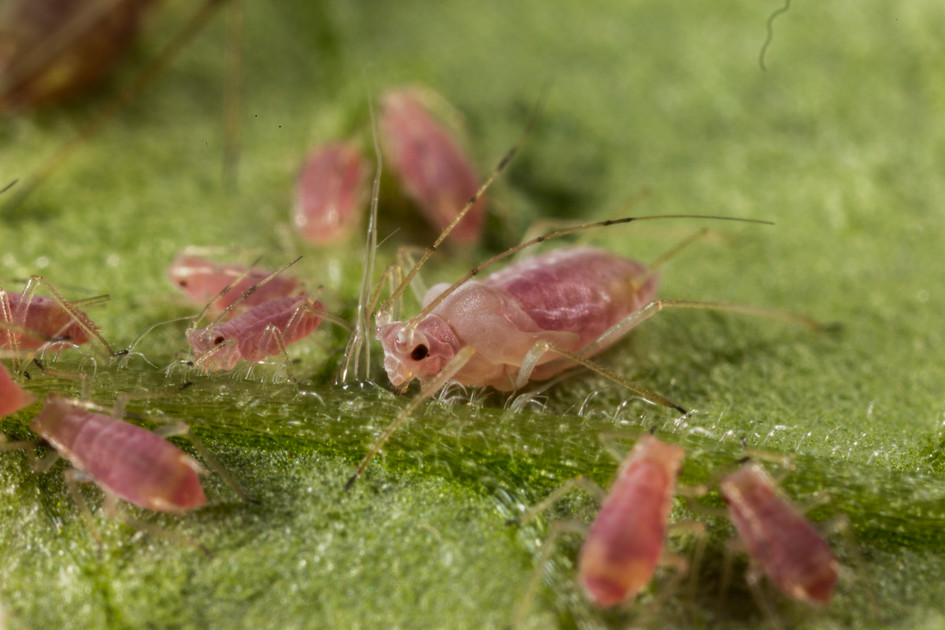
Aphids are small, soft-bodied insects belonging to the superfamily Aphidoidea within the order Hemiptera. They are typically pear-shaped and range in color from green, black, and brown to red and yellow. Measuring just 1–4 mm, they often go unnoticed until their populations explode.
Aphids feed by inserting their piercing-sucking mouthparts into plant tissue, extracting sap. This weakens plants, causes distorted growth, and, in severe cases, can lead to plant death.
Common Species of Aphids
While there are over 4,000 species worldwide, a few are especially notorious in horticulture and agriculture:
Green Peach Aphid (Myzus persicae) → Infests a wide range of vegetables and ornamentals; a major virus vector.
Cotton Aphid (Aphis gossypii) → Affects cucurbits, chrysanthemums, peppers, and more.
Potato Aphid (Macrosiphum euphorbiae) → Common on solanaceous plants and ornamentals.
Cannabis Aphid (Phorodon cannabis) → An emerging issue for cannabis growers, often hidden on stems and leaf undersides.
Learn more about Root Aphids in our dedicated page for root aphid control.
Where are Aphids Found?
Effective aphid detection starts with a close look at the parts of the plant where aphids settle first and where the earliest signs of feeding appear. The most consistent locations for early colonies are the undersides of leaves, the newest unfolding growth, and the tight spaces where leaves meet the stem. Aphids prefer these sheltered areas because the tissue is soft and easy to penetrate, so early clusters often sit along leaf veins or gather inside slightly curled or folded leaves. Depending on the species, they may be green, yellow, black, or reddish, which allows them to blend into plant tissue unless examined closely.
Damage becomes noticeable early in the feeding process. One of the first indicators is mild distortion in new leaves. Fresh growth may appear slightly twisted, puckered, or uneven, which happens because aphids inject saliva into tender tissue as it expands. Even small populations can create this distortion, making it a reliable early sign in many crops.
Another clear indicator is a developing shine on the surface of leaves. This begins as a very thin layer of honeydew that reflects light more than the surrounding tissue. As feeding continues, the residue becomes tacky, and over time the surface may darken as sooty mold begins growing on top of the sugary deposits. Even a light coating of this mold signals that aphids have been present for some time.
Ant activity can also point toward developing colonies. Ants frequently travel up stems to collect honeydew, and repeated movement toward new growth often corresponds with aphids feeding nearby. Shed aphid skins are another clue. As aphids grow, they leave behind white, papery cast skins that accumulate along stems and at the bases of leaves. These skins can be easier to spot than the insects themselves, especially in dense foliage.
Consistent scouting involves revisiting plants regularly and noting how these signs progress. Increasing distortion in new growth, expanding patches of honeydew, more visible cast skins, and enlarging clusters of nymphs all indicate rising aphid pressure. Observing these changes over time makes it possible to respond while populations are still small enough for biological control to establish and maintain long‑term control.
Why Are Aphids a Problem?
Aphids damage plants in several ways:
Sap feeding → Stunts growth, curls leaves, and weakens plants.
Honeydew secretion → Creates sticky surfaces, attracting ants and leading to sooty mold growth.
Virus transmission → Capable of spreading dozens of plant viruses within minutes of feeding.
Symptoms include:
- Yellowing, curling, or distorted leaves
- Stunted plant growth
- Sticky residue on leaves and surfaces
- Black fungal growth (sooty mold)
- Ants “farming” aphid colonies for honeydew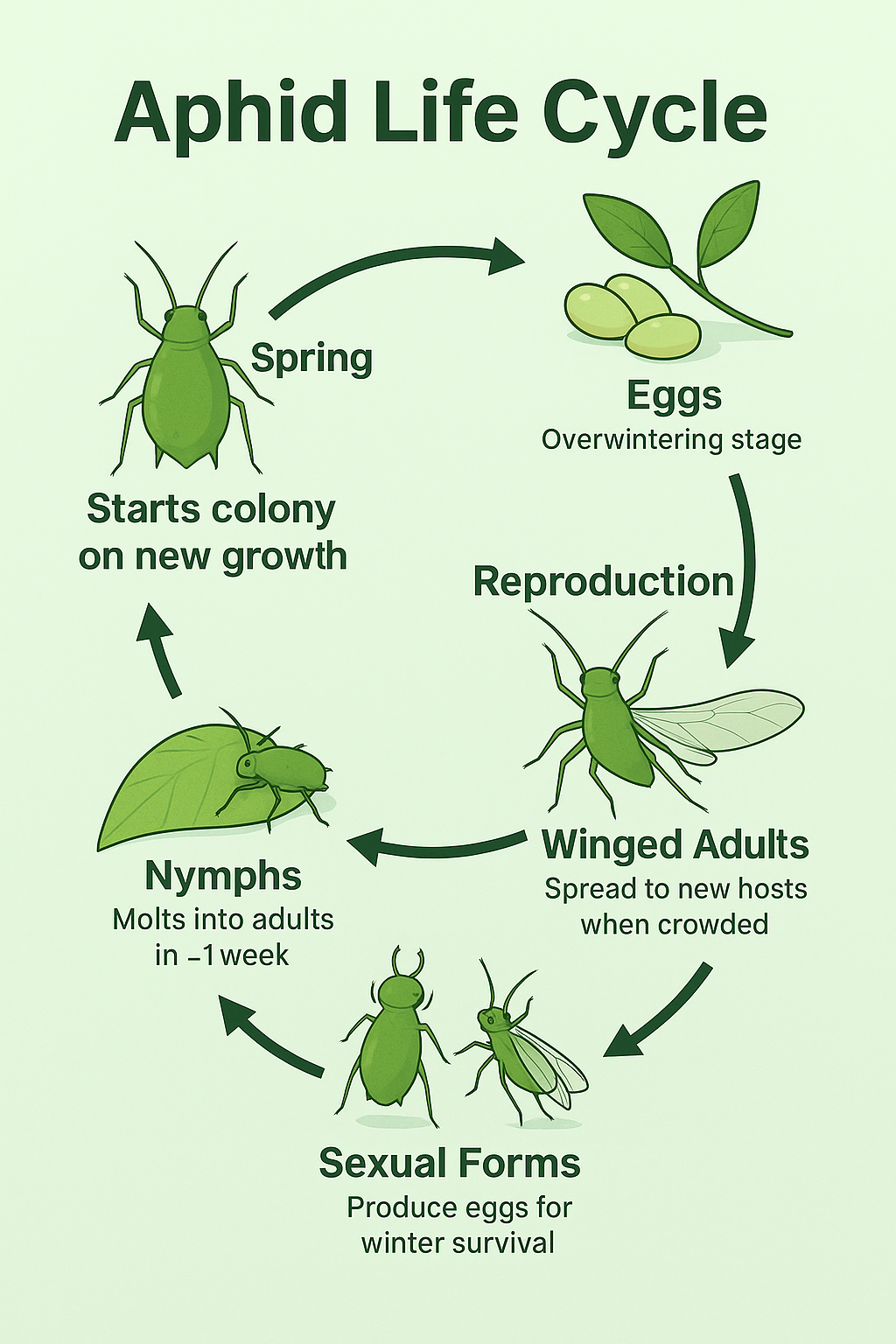
Aphid Life Cycle
One reason aphids are so difficult to manage is their rapid reproductive cycle:
- Females often reproduce without mating (parthenogenesis).
- A single aphid can give birth to 60–100 live young in a few weeks.
- Winged forms appear when colonies grow crowded, allowing them to spread to new plants.
- Indoors or in greenhouses, aphids can reproduce year-round.
Biological Control of Aphids
Biological control is the most sustainable way to manage aphids long-term. Releasing natural enemies allows nature to do the work for you.
Green Lacewing (Chrysoperla carnea)
Lacewing larvae are among the most adaptable aphid predators available. Often called “aphid lions,” the larvae actively search through the canopy for soft-bodied insects and consume large numbers during their short but intense predatory stage. They feed on all aphid life stages except fully hardened adults, and their ability to move easily across leaf surfaces allows them to find colonies hidden deep within new growth. Lacewings perform well in a wide range of growing environments, making them a dependable option for both preventative and curative programs. Shop Lacewings
Parasitic Wasps (Aphidius colemani & A. ervi)
Aphidius wasps provide highly targeted control by seeking out individual aphids and laying eggs inside them. Once parasitized, the aphid stops feeding and eventually transforms into a tan, swollen “aphid mummy.” This process interrupts colony growth quickly, and new adult wasps emerge from the mummies to continue the cycle. Aphidius colemani specializes in smaller species such as green peach aphid and melon aphid, while Aphidius ervi targets larger-bodied species such as potato aphid. These wasps work especially well in greenhouses, indoor gardens, propagation spaces, and other controlled environments Shop Aphidius
Predatory Midges (Aphidoletes aphidimyza)
Aphidoletes midges are powerful predators suited for heavier aphid pressure. The adults lay eggs near aphid colonies, and the bright orange larvae attack aphids at all life stages, including larger adults. Their hunting behavior is highly active, making them especially effective in dense canopies where aphids hide in folded leaves or tucked growth points. These midges prefer warm, humid conditions and are most effective in greenhouse environments or other enclosed spaces where their life cycle can progress without interruption. Shop Aphidend
Lady Beetle Larvae (Adalia bipunctata)
Adalia larvae are highly effective aphid predators during their active feeding stage. Each larva consumes large numbers of aphids daily, targeting all soft-bodied stages and moving quickly across foliage to locate colonies. Because this product contains only larvae, it delivers immediate impact without the variability associated with adult beetle dispersal. Larvae remain focused on feeding until pupation, making them an excellent choice for rapid reduction of visible aphid populations in localized hotspots. Shop Aphidalia
Implementing Biological Control in Plants
Biological control is one of the most reliable and sustainable ways to manage aphids over the long term. Introducing natural enemies directly into the crop allows predatory species to locate and suppress colonies in a way that aligns with plant physiology, environmental conditions, and aphid behavior. Each natural enemy contributes differently, and using the right species at the right stage of aphid development can make a significant difference.
To successfully implement biological control for aphids in plants, follow these practical tips:
Identify the Target Problems: Accurate identification of the aphid species present in your plants is essential for selecting the appropriate biological control agents. Regular monitoring and scouting can help detect infestations early.
Choose the Right Beneficial Insects: Select beneficial insects that are specific to the aphid species and suited to the indoor environment. Consider factors such as temperature, humidity, and the presence of other beneficial organisms.
Release Beneficial Insects at the Right Time: Timing is crucial for the effectiveness of biological control. Release beneficial insects when aphid populations are low to moderate, allowing them to establish and reproduce before problem numbers become overwhelming.
Provide Suitable Habitats: Create a conducive environment for beneficial insects by providing suitable habitats, such as flowering plants that offer nectar and pollen. Avoid the use of broad-spectrum pesticides that can harm beneficial insects.
Monitor and Evaluate: Regularly monitor aphid and beneficial insect populations to assess the effectiveness of the biological control program. Adjust release rates and strategies as needed to maintain effective problem management.
Additional Natural Methods for Aphid Control
In addition to biological control, several other natural methods can help manage aphid infestations in plants:
Neem Oil: Neem oil is a natural insecticide derived from the neem tree. It can be effective in controlling aphids by disrupting their feeding and reproductive processes. Apply neem oil as a foliar spray, ensuring thorough coverage of the infested areas.
Insecticidal Soap: Insecticidal soap is a contact insecticide that can help control aphids by breaking down their protective coating. Apply insecticidal soap directly to the aphids, ensuring thorough coverage.
Rubbing Alcohol: Dabbing aphids with a cotton swab soaked in rubbing alcohol can help kill them on contact. This method is particularly useful for small infestations and can be combined with other control methods for greater effectiveness.
Pruning and Disposal: For heavily infested plants, pruning and disposing of affected plant parts can help reduce aphid populations. Be sure to dispose of the pruned material properly to prevent the spread of aphids to other plants.
Conclusion
Aphids are a universal pest, but they don’t have to be a persistent problem. By understanding their life cycle and applying a mix of cultural, mechanical, and biological strategies, you can keep populations in check — naturally and sustainably.
Ready to let nature take the lead? Explore our full range of Beneficial Insects for aphid control.
Learn More: Lions, Tigers, and Bugs, Oh My! - Natural Enemies
FAQs
Q: Will beneficial insects fly away indoors?
A: Some will, but many (like lacewing larvae and Aphidius wasps) remain on plants until food is scarce.
Q: How long until I see results?
A: Typically within 7–14 days, depending on environmental conditions.
Q: Can I combine different beneficial insects?
A: Yes - in fact, using multiple species (e.g., lacewings + Aphidius) improves coverage.
