
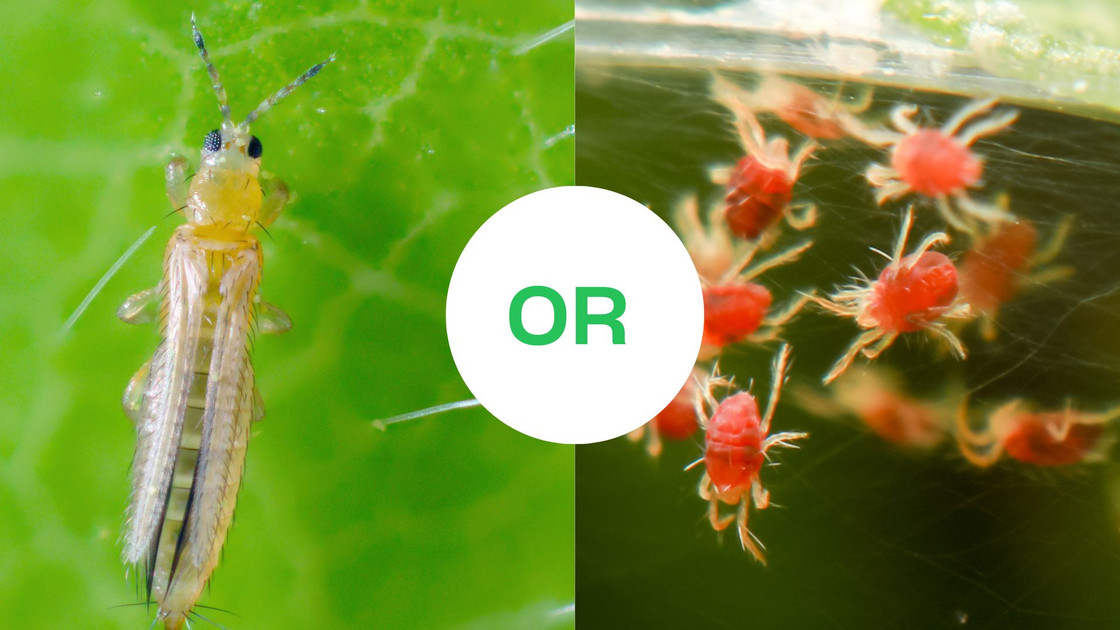
How to tell between Thrips and Mites: A Diagnostic Guide
Dec 10, 2025
Thrips and mites are among the most persistent and economically significant pests in greenhouse ornamentals, cannabis, indoor vegetables, and propagation systems. Because both groups feed on soft plant tissue and disrupt cellular integrity, the injuries they create often resemble one another during early attack. Small chlorotic patches, irregular distortions, bronzing, flecking, and loss of vigor can all emerge before the insects or mites themselves are detected, and misdiagnosis at this early stage frequently results in weeks of ineffective intervention. This guide explains the biological basis of the feeding mechanisms, the diagnostic patterns that arise from those mechanisms, and the distinctions that allow professional growers to correctly identify thrips damage versus the injury caused by spider mites, broad mites, or russet mites. The distinctions matter, because each pest responds to a completely different set of biological control agents, and choosing the wrong one wastes time and increases outbreak severity.
Thrips create damage through a rasping–sucking feeding mechanism. Their mouthparts scrape the surface of epidermal cells, rupture them, and then ingest the contents. This destruction creates empty, air-filled cavities below the epidermis, and because the cell walls remain partly intact, they form a reflective surface that appears as silver or bleached scarring when viewed under normal greenhouse lighting. UC IPM notes that this reflective quality is the most reliable diagnostic cue for thrips injury and is often one of the earliest visible signs of infestation (UC IPM Thrips, 2021). On crops with colored blossoms, thrips feeding on developing floral tissue causes streaks, flecks, or dull patches on petals long before deformity becomes obvious. As populations increase, the feeding extends to developing leaves and meristems, causing irregular expansion of young tissue; however, even in these distorted leaves, thrips injury retains the characteristic silvery sheen due to the collapsed air-filled cells beneath the epidermis.
Spider mites, by contrast, do not produce reflective silvering. They feed by puncturing individual cells using stylet-like mouthparts, and Oregon State University Extension describes this as a “sucking out” of chlorophyll from discrete cells, leaving behind pale dots known as stipples (OSU Extension, 2021). While these speckles may initially resemble minor nutritional irregularities, they quickly differentiate into a recognizable pattern as many adjacent chloroplast-rich cells are depleted. As the stippling expands, affected leaves develop a dull, bronzed, or yellow cast that spreads upward from older leaves to newer foliage. This progression is diagnostic: spider mites often begin in lower foliage where humidity is higher and air movement is lower, and then move upward as populations increase. In warm, dry conditions, mite reproduction accelerates dramatically, and OSU Extension notes that population spikes often coincide with rapid environmental changes such as sudden heat waves or canopy thinning (OSU Extension, 2021). Thrips do not follow this vertical progression pattern, and their damage rarely accumulates into a uniform bronzing of the leaf surface.
Broad mites and russet mites create yet another category of injury that differs from both thrips and spider mites. Their feeding activity targets meristematic tissues and young, expanding foliage. Rather than producing silvering or stippling, broad mites and russet mites cause a disruption in the plant’s hormone balance, leading to the characteristic hardening, cupping, thickening, and deformation of new leaves. University of Maryland Extension describes this as a growth-regulator imbalance caused by the injection of saliva during feeding (UMD Extension, 2020). The resulting foliage appears distorted and leathery, often with shortened internodes and a “tight” architecture in the growth tip. Crucially, unlike thrips injury, no reflective silvering appears on the distorted tissue. Unlike spider mites, no stippling precedes the deformation. These distinctions, while subtle to inexperienced eyes, become highly reliable once growers learn to look for them.
When symptoms first appear, growers frequently encounter borderline cases where multiple pests could be responsible. In such cases, the spatial distribution of the symptoms becomes a decisive factor in diagnosis. Thrips preferentially attack flowers, buds, and new leaves, so damage typically appears first on the youngest tissue. Spider mites begin on older leaves and progress upward. Broad mites and russet mites almost never appear on mature leaves; their injury is exclusively concentrated in the growth tip and the tissue formed immediately afterward. The absence or presence of reflective silvering is another reliable separator. Thrips injury always has a dull shine when viewed at an angle, while mites never produce reflective surfaces. Similarly, the appearance of mottling composed of thousands of tiny points is overwhelmingly indicative of spider mites rather than thrips or broad mites. And of course, the presence of webbing, even in minimal quantity, is exclusive to spider mites and does not occur with thrips, broad mites, or russet mites.
Because each pest responds to completely different biological control agents, a correct diagnosis ensures that biocontrol inputs are not wasted. For thrips, Amblyseius swirskii remains one of the most widely used preventative predators in warm, high-light conditions, while Amblyseius cucumeris is more suited to propagation and cooler environments. These predatory mites feed on young thrips larvae, and when combined with Orius insidiosus—a predatory minute pirate bug capable of consuming both larvae and adult thrips—they form the backbone of thrips suppression programs in ornamentals, cannabis, and indoor vegetables. By contrast, none of these predators provide meaningful control of spider mites. Spider mite management relies on species such as Phytoseiulus persimilis, a highly specialized predator that provides rapid curative action in hot spots, or broader-spectrum species such as Amblyseius andersoni or Amblyseius californicus that maintain low-level suppression across variable environments.
Broad mites and russet mites require yet another biological approach. These mites are microscopic and colonize meristems, so predators must be able to access tight plant architecture and tolerate the microclimate of new tissue. Amblyseius swirskii performs well in warm greenhouse climates where broad or russet mites are present, while Amblyseius andersoni provides broader temperature tolerance and is preferred in mixed-crop production where environmental conditions vary. Because russet mites often cause damage before they are detected visually, programs using these predators are typically deployed preventatively rather than curatively.
Across all crops, the accuracy of diagnosis depends less on visual identification of the pest itself and more on the grower’s ability to interpret patterns in tissue response. Reflective silvering belongs to thrips. Stippling and bronzing belong to spider mites. Hard, distorted new growth lacking silvering belongs to broad or russet mites. Webbing belongs exclusively to spider mites. Damage beginning in flowers and new leaves aligns with thrips; damage beginning in older leaves aligns with spider mites; damage concentrated in the growth tip aligns with broad mites or russet mites. Once these distinctions become second nature, growers can act more quickly, deploy biologicals more effectively, and prevent economic losses before they spread through a crop block.
UC Statewide Integrated Pest Management Program (UC IPM). “Thrips: Floriculture and Ornamental Nurseries.” 2021.
Oregon State University Extension. “How to Recognize and Manage Spider Mites” 2021.
University of Maryland Extension. “Mites.” 2020.
UC Statewide Integrated Pest Management Program (UC IPM). “Spider Mites: Home and Landscape.” 2021.
