
Fungus Gnat Larvae: "What's Eating My Roots?" Soil-Stage Identification and Control
Jan 12, 2026
Fungus gnats are often dismissed as a minor nuisance when adults drift around containers or benches, but the real damage occurs below the surface. The larval stage lives in the growing media, where it feeds on fine roots, root hairs, and organic films. This feeding slows growth, reduces nutrient uptake, and creates entry points for root pathogens. Effective control depends on understanding the soil stage, choosing biological tools that operate where larvae actually live, and preventing pressure from rebuilding through moisture and sanitation management. This guide focuses entirely on the soil stage so control decisions are directed where they matter most.
Shop the soil stage
- Attack larvae (Soil drench): Entonem
- Guard the soil(Predatory mites): Entomite‑M
- Track trends (Monitoring): Horiver Yellow
- Spray with Confidence (Dip or Drench): Isarid
Step‑by‑step quickstart
- Confirm fungus gnats
- Start drenches: Apply Entonem weekly, ensuring full bottom‑of‑pot contact; choose Capsanem if soil is consistently warm.
- Guard the surface: Sprinkle Entomite‑M around stems and along bench crevices to suppress larvae at the surface.
- Fix moisture: Implement light surface dry‑down and eliminate saucer standing water and algae films.
- Track trends: Use Horiver cards for weekly counts; continue biologicals until trends fall across consecutive weeks.
What Fungus Gnat Larvae Look Like in Soil
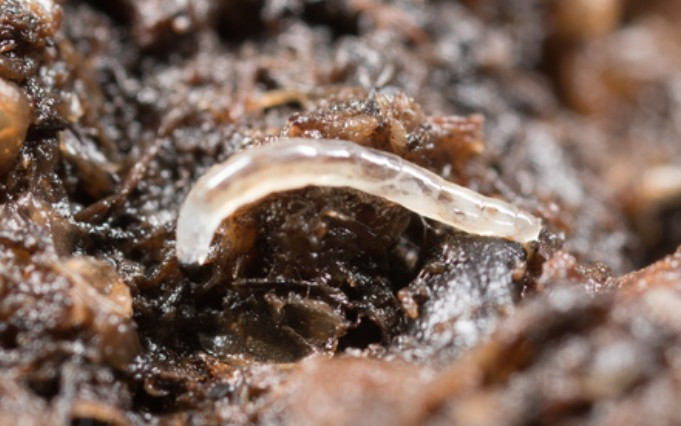
Fungus gnat larvae are slender, translucent to milky white, and typically measure about one quarter of an inch, or six to seven millimeters, in length. A distinct black head capsule is visible at the front of the body and is the most reliable identifying feature. Larvae are often associated with moist areas of the growing media where algae, decomposing organic material, or tender root tissue is available.
In many systems, larvae are commonly found near the surface because egg laying is encouraged by damp media, algae films, and organic residues. However, this is not universal. In porous substrates such as coco, coir, or bark mixes, and in containers where irrigation keeps the profile evenly moist, eggs can be deposited deeper in the potting medium and larvae may feed well below the surface along root zones. In rockwool slabs and channels, larvae frequently concentrate along slab edges, channel bottoms, and areas where condensation or leaf contact maintains moisture. Outside containers, larvae can also develop in undisturbed wet pockets such as drainage mats, saucers, floor cracks, plumbing runs, and areas beneath condensate drips.
Larvae are most likely to be observed visually under high pressure, when working with open or highly porous media, or when containers allow access from below through drainage holes. Under low to moderate pressure, larvae are often present but difficult to see, even when actively feeding.
Why Adult Counts Matter More Than Seeing Larvae
Visible adult fungus gnats are sufficient evidence that larvae are present somewhere in the growing environment. Adults do not persist unless eggs are being laid and larvae are developing in soil, substrate, or protected wet pockets. Because larvae are small, translucent, and often hidden deeper in the media, waiting for visual confirmation can delay action and allow pressure to build.
Adult monitoring should be viewed as a decision-making tool rather than a treatment target. Sticky cards and flight activity indicate when soil-stage control is needed and help determine whether pressure is increasing, stabilizing, or declining. Treating only adults without addressing the soil stage may temporarily reduce visible flyers but will not interrupt the cycle that drives ongoing pressure and root damage.
Biological Control for the Soil Stage
Effective fungus gnat management relies on biological tools that function in the soil and remain active where larvae feed.
Entonem, which contains the beneficial nematode Steinernema feltiae, is applied as a soil drench to target fungus gnat larvae directly. After application, the nematodes move through water films in the media, locate larvae, and infect them, leading to mortality within a short period under suitable conditions. Entonem is widely used in greenhouse, nursery, hydroponic, and houseplant systems for its versatility against not just fungus gnats, but thrips as well.
Porous media can harbor larvae in small voids. Drench thoroughly to the bottom of the pot, and consider repeat weekly drench schedules in high‑density areas. Add Entomite‑M around stems and along bench seams to maintain surface suppression.
Applications should thoroughly wet the entire media surface and allow solution to penetrate through the full depth of the container or slab. While adult trends remain elevated, applications are typically made on a weekly cadence and then reduced as counts decline. As a planning guideline, one small box treats roughly one thousand square feet and one large box approximately ten thousand square feet, with adjustments made for crop density and moisture patterns. Entonem performs best near seventy degrees Fahrenheit and generally within soil temperatures of fifty-seven to seventy-nine degrees Fahrenheit. In non-soil media, contact time is shorter and larvae may occupy pores deeper in the profile, so thorough, full-profile drenching is critical.
Entomite-M, which contains the predatory soil mite Stratiolaelaps scimitus, provides persistent suppression in the upper media and crown zone. These mites actively search the soil surface and consume fungus gnat larvae and other small soil invertebrates. Entomite-M is applied by sprinkling evenly across the media surface and around the stem base. In greenhouse floors and bench systems, it can also be placed into crevices near pipes, seams, and joints where larvae develop. This predator excels in preventative programs, propagation areas, and consistently damp environments by maintaining continuous pressure where eggs are commonly laid.
Monitoring, Measuring, and Decision-Making
Sticky cards provide the trend line that guides soil-stage decisions. Adults are the signal, but direction over time determines whether to continue or taper treatments. A common baseline is one yellow sticky card per approximately two thousand square feet at canopy level, with additional cards placed at doors, vents, and gables where adults enter and settle.
Counts should be taken weekly and recorded consistently, including zero counts. Soil drenches and surface predators should be maintained while counts rise or plateau. Tapering should begin only after two to three consecutive weeks of clear decline across the growing area.
The soil stage of fungus gnats should be treated as the issue when controlling gnats, rather than simply spraying adults. Adult fungus gnats are useful for monitoring trends, but larvae are responsible for root damage and slowed growth. With weekly soil drenches, surface predators, and improved sanitation, adult counts often begin to decline within a few weeks, but treatments should continue until trends stabilize at a lower level. When soil temperatures remain in the mid-to-upper seventies Fahrenheit, Capsanem is preferred. When temperatures return to the sixties or low seventies, Entonem is typically the better choice.
Take Control of the Soil Stage
Fungus gnat pressure does not resolve on its own. By recognizing that adult activity confirms soil-stage development, applying biological controls that operate through the full media profile, and correcting the moisture conditions that support egg laying and larval survival, growers can protect roots, restore growth, and prevent pressure from rebuilding over time.
Read More
How to Solve Fungus Gnats
Cold-Season Fungus Gnat Control
How to Stop Fungus Gnats Before They Start — Naturally
FAQ
Do I spray adults or treat soil?
Treat the soil stage. Adults are the signal you measure with sticky cards, but larvae are what harm roots and slow growth.
How quickly will I see improvement?
With weekly soil drenches, surface predators, and sanitation, adult counts often begin to decline within a few weeks. Continue until trends hold steady in a lower range.
