
A Grower's Guide to Flat Mites
Nov 28, 2025
Flat mites are a frequently overlooked causes of slow, subtle decline in greenhouse, nursery, and indoor-grown plants. Their exceptionally small size, their tendency to remain anchored in concealed plant structures, and the gradual way their feeding alters tissue make them difficult for growers to diagnose until damage is well established. Many plants commonly associated with modern horticulture—especially tropical foliage, citrus, palms, ornamentals, and other broadleaf crops—provide the sheltered environments that allow flat mites to persist for long periods without producing obvious signs. Because the early stages of a flat mite problem resemble nutritional, environmental, or physiological issues, growers often discover the underlying cause only after the plant has developed widespread bronzing, stiffened new growth, or texture changes.
Understanding how flat mites behave, how their damage develops, and how to identify early warning signs is essential for effective management. Because flat mite activity progresses long before any visible indication appears, achieving control depends on pairing accurate diagnosis with control tools capable of reaching the concealed feeding sites where these mites establish themselves. The following guide outlines the practices and biological control systems most consistently used by professional growers to regain control and prevent recurring flat mite problems.
1. What Flat Mites Are and Why They Are Hard to See
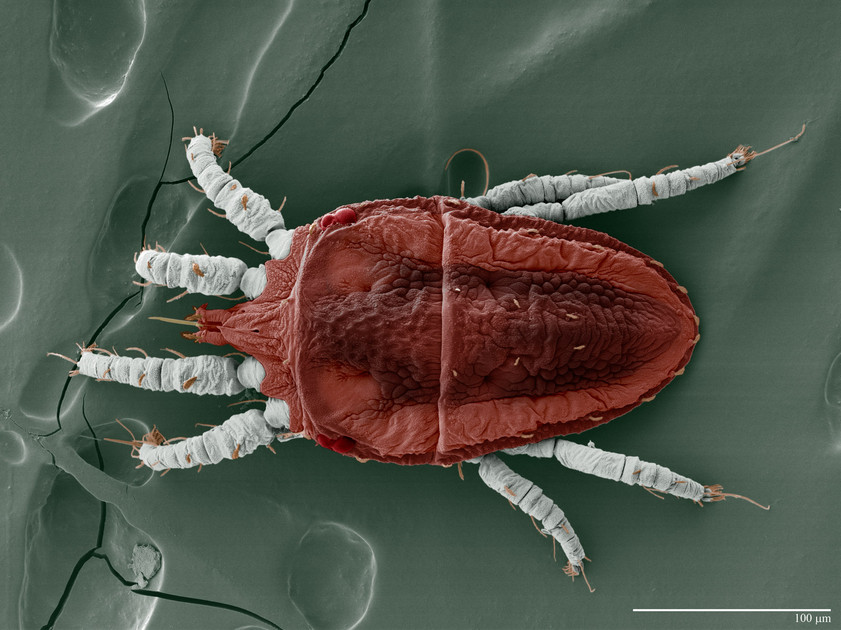
Flat mites, members of the family Tenuipalpidae, are among the most inconspicuous pests encountered in horticulture. Their bodies are extremely small and laterally compressed, allowing them to cling so tightly to the plant surface that they appear as nothing more than tiny specks—if they appear at all. The University of Florida Extension emphasizes that flat mites typically position themselves in sheltered areas such as leaf undersides, petiole bases, creases along midribs, stem joints, and other protected microhabitats where most growers do not routinely inspect (UF/IFAS 2023). The combination of their flattened shape, their close contact with the plant, and their slow, deliberate movement makes them nearly invisible without magnification.
In practice, this means that flat mite problems often begin far earlier than growers realize. The mites rarely move across open surfaces, preferring instead to remain in consistent contact with tissue for long periods. Their anchored posture allows them to survive disturbances that would dislodge more mobile pests. Many growers across citrus, tropical foliage, ornamentals, cannabis, palms, and numerous houseplants report noticing subtle plant changes long before any mite is seen. Flat mites—including Brevipalpus phoenicis, B. yothersi, B. lewisi, and Tenuipalpus pacificus—exhibit this same behavior across diverse hosts and environments.
Flat mite eggs are flattened and adhere firmly to the leaf surface, blending seamlessly with the surrounding tissue. Newly hatched larvae remain close to the hatching site, moving very little and feeding within the same protected area. As the protonymph and deutonymph stages develop, they maintain the same adherence to the tissue and expand feeding only gradually. Adults continue this pattern, often living for weeks or months depending on environmental conditions. Throughout these stages, flat mites lack the conspicuous visual cues—such as webbing or rapid movement—that growers associate with other mite groups. This creates a window of opportunity for flat mite populations to become established deep inside the canopy before outward signs draw attention.
These characteristics—concealed feeding, limited movement, and prolonged anchoring in protected plant structures—make flat mites poorly suited to surface-level treatments and instead require control systems capable of entering the same hidden microhabitats where these mites reside.
Across ornamental production, greenhouse environments, tropical foliage cultivation, and home growing, this quiet, entrenched feeding habit is why flat mites remain among the most overlooked pests in horticulture. Their ability to exploit structural features of plants, their near-invisibility, and their slow but persistent expansion all contribute to their reputation as one of the most subtle and diagnostically challenging mite groups growers face today.
2. How Flat Mites Affect Plant Growth
Flat mites cause damage by inserting slender, needle-like mouthparts into the outermost layers of plant tissue. Their feeding is slow, uniform, and highly localized. The University of Minnesota Extension explains that this type of feeding causes symptoms that develop gradually and may not become visible until significant tissue changes have accumulated over time (UMN Extension 2022). This explains why growers frequently misinterpret early flat mite activity as nutritional or environmental stress.
On young leaves, flat mites may interfere with normal cell expansion, resulting in new growth that appears hardened, stiffened, or slightly distorted. These changes often occur before discoloration appears, giving the impression that the plant is responding to moisture or fertility issues. In crops such as ficus, philodendron, schefflera, dracaena, citrus, palms, and other tropical ornamentals, the earliest sign is often a subtle loss of sheen. Plants that previously had a glossy or supple texture may take on a muted or slightly rough finish. As feeding continues and pressure levels increase, affected tissue develops smooth, uniform bronzing that contrasts with the plant’s normal coloration. This bronzing tends to follow the direction of the mite’s spread, beginning near the protected areas where mites settle and radiating outward.
In citrus, characteristic bronzing often appears along the midrib or on stems where Brevipalpus species concentrate their feeding. In palms and related tropical plants, species such as Raoiella indica can produce discoloration along leaflets and fronds, sometimes with tissue thickening or roughening. In numerous ornamentals—gerbera, fuchsia, poinsettia, hibiscus, succulents—fine russeting may appear on the undersides of leaves or along stems, though it may not be recognized as pest damage until advanced.
A major diagnostic challenge is that flat mite damage resembles other physiological issues. Bronzing may be confused with magnesium deficiency. Surface dulling may be mistaken for humidity imbalance. Slight distortions in new growth may suggest calcium-related disorders. Because symptoms accumulate gradually, the plant may decline slowly while the true cause remains hidden.
Flat mite feeding typically begins within concealed portions of the plant, such as leaf bases or tight nodes. As a result, the first visible symptoms often appear in isolated patches rather than uniformly across the plant. This patch-dominated pattern is a key diagnostic feature. By the time symptoms appear on visible surfaces, flat mites may have been active for weeks or months inside the canopy. Because these symptoms progress quietly and early signs are easy to overlook, growers frequently turn to biological control agents to restore control before damage spreads further.
3. Why Flat Mites Are So Common in Modern Growing Systems
Flat mites are consistently encountered across greenhouse, nursery, and indoor production systems because the conditions these environments provide align closely with the mites’ natural strengths. Their biology favors sheltered, stable microhabitats, and many crops grown today—tropical foliage, citrus, palms, broadleaf ornamentals, and numerous specialty plants—naturally create the tightly layered leaves, woody nodes, folded tissue, and protected petiole attachments where flat mites can anchor and feed for extended periods.
Greenhouses and controlled indoor spaces maintain steady temperatures, predictable humidity, and continuous plant growth. The University of California notes that these uninterrupted growing conditions allow mite development to proceed without seasonal breaks (UC ANR 2022). Rather than causing an increase in flat mites, these environments simply remove the natural disruption that would typically slow their activity in the field. As a result, flat mites fit seamlessly into the production cycles of crops that maintain foliage year-round.
Plant movement also plays a major role in why flat mites appear so regularly in commercial and consumer settings. Propagated cuttings, liners, finished plants, and specimen stock routinely pass through multiple growers, distributors, interiorscape facilities, and retail environments. Because flat mites cling closely to the plant surface and remain hidden in protected zones, they are capable of traveling undetected through normal handling practices. Eggs and early developmental stages are particularly difficult to see and can survive shipping, routine watering, and basic sanitation.
Another factor contributing to their consistent presence is the emphasis on foliage quality in high-value ornamental production. Growers routinely examine leaves for gloss, texture, uniformity, and symmetry. This heightened attention makes the subtle bronzing and texture changes associated with flat mite feeding far more noticeable. The mites themselves are not more widespread; growers are simply more aware of their symptoms due to modern aesthetic standards.
Taken together, these characteristics explain why flat mites are commonly found in greenhouses, nurseries, and indoor plant systems. Their discreet biology, the structure of the crops grown, the movement of plant material, and the continuous growing conditions typical of controlled environments all contribute to their regular presence. These factors make preventative biological control a practical and widely adopted approach in crops known to support concealed mite activity.
4. Biological Control Options: The Role of Spical and Swirskii
Biological control is particularly effective for flat mite management because predatory mites can access the same concealed spaces where flat mites feed. Two species dominate commercial biological control programs: Neoseiulus californicus (Spical) and Amblyseius swirskii (Swirskii). Each species plays a different—but complementary—role in reducing flat mite pressure across the plant canopy and providing growers with a dependable, long-term control system.
Neoseiulus californicus remains active even when prey densities are low. Michigan State University Extension notes that N. californicus excels at locating flat mites in layered foliage, mature leaves, crevices, and other protected structures (MSU Extension 2023). This makes it especially effective in crops with complex canopy architecture where flat mites anchor deeply.
Amblyseius swirskii thrives on new foliage and leaf undersides. UF/IFAS explains that Swirskii is highly active on emerging growth, where juvenile flat mites are often found (UF/IFAS 2022). It is agile, responsive to chemical cues associated with prey presence, and capable of maintaining high foraging intensity across a range of environmental conditions.
Because flat mites anchor deeply and move slowly, contact sprays often fail to reach them consistently, whereas predatory mites can physically enter these protected microhabitats. For this reason, predatory mites remain the most reliable control option in commercial and indoor production systems.
A deployment strategy that positions Spical within interior canopy zones and Swirskii across developing foliage provides consistent long-term control by targeting both concealed adult populations and early juvenile activity. Many growers incorporate routine sachet placement as a preventative measure in crops that commonly support hidden mite activity.
5. Monitoring and Early Recognition
Monitoring flat mite activity requires a deliberate, texture-based approach. The University of California recommends examining leaf undersides, midribs, petiole bases, growing tips, and interior foliage, as these areas support early flat mite activity before symptoms appear (UC IPM 2023). These areas must be checked routinely, especially in plants with layered or tightly structured growth.
Because flat mites remain in tight contact with the leaf surface, they rarely appear on sticky cards. Mechanical monitoring tools contribute little to early detection. Hand lenses, macro lenses, and trained visual inspection remain the most effective approach. Growers often detect early activity through newly formed leaves that feel stiff or appear slightly distorted, glossy foliage that becomes dull or matte, or bronzing that develops smoothly rather than in distinct speckles.
Patchlike patterns in sheltered or partially shaded areas are strong indicators of flat mites. Taking time to examine concealed tissue directly is essential. Early confirmation of flat mite activity allows biological control agents to establish where needed before populations expand, making routine monitoring a critical component of maintaining control.
6. Supporting Biological Control Through Cultural Practices
Cultural practices are essential for maintaining effective biological control of flat mites. The University of Minnesota Extension emphasizes that healthy plants with balanced irrigation, adequate airflow, and appropriate nutrition support more consistent predator activity across multiple generations (UMN Extension 2020). Flat mites thrive in areas with limited airflow, humidity pockets, and older foliage. Removing aging leaves reduces the number of sheltered sites where flat mites may reside. Pruning to maintain open canopies increases airflow and provides predatory mites better access throughout the plant.
Balanced irrigation is crucial, as overly dry or overly moist conditions can impede predator movement. Cultural support also strengthens plant resilience, enabling plants to tolerate low levels of feeding while biological control agents establish. Inspection protocols for incoming material remain vital, as early-stage flat mite populations are almost always introduced through new stock with no visible signs of a problem.
When the canopy is accessible and environmental conditions are optimized, Spical and Swirskii establish more quickly, disperse more effectively, and maintain consistent control over time. Cultural practices, in combination with biological control, create a stable management system that prevents the gradual buildup of flat mite populations and supports long-term prevention.
Conclusion
Flat mites are among the most discreet and persistent pests in horticulture, capable of feeding for extended periods before symptoms draw attention. Their flattened bodies, slow movement, and preference for concealed plant structures allow them to remain undetected across many crop types. Fortunately, their biology is well understood, and modern biological tools provide growers with dependable long-term control.
For professional growers and serious plant managers, successful flat mite control depends on integrating biological control agents into a proactive management plan rather than relying on reactive or surface-level treatments. The combined use of Spical (Neoseiulus californicus) and Swirskii (Amblyseius swirskii), supported by routine monitoring and cultural adjustments, offers a durable and repeatable control system. Incorporating these practices ensures long-term prevention and minimizes the risk of concealed flat mite activity becoming established again. With accurate diagnosis, proactive cultural support, and strategic biological control, flat mites transition from a mysterious and misidentified problem to a consistently managed component of an integrated plant production system.
Extension References
UF/IFAS (2023). Tenuipalpid Mites on Ornamental Plants.
UF/IFAS (2022). Biological Control in Greenhouse and Ornamental Production.
UC ANR (2022). Mite Management in Nursery and Greenhouse Crops.
UC IPM (2023). Integrated Pest Management for Floriculture and Nurseries.
UMN Extension (2020). Biological Control in Integrated Pest Management.
UMN Extension (2022). Diagnosing Mite Issues in Ornamental Crops.
MSU Extension (2023). Predatory Mites in Greenhouse Crops.
